BMW 3 Series stalling problems: what 197 owners reported
Owners filed 197 complaints with NHTSA describing a BMW 3 Series that stalled, lost power or shut off while driving. That is 11.8% of the 1,671 complaints on file for the model. Most of them concern 2012 to 2014 model years: 148 of the 197 reports, or about three in four. Owners name the engine, the fuel system, the power train and the electrical system most often.
Only one NHTSA recall in the data matches part of this picture, and it covers 2013 to 2016 328d xDrive cars with a damaged constant-velocity joint that can cause a loss of power to the rear wheels. It does not cover every car in these reports. If this is not your case, read the full BMW 3 Series problem report.
TL;DR
- 197 stalling or power-loss reports out of 1,671 complaints for the 3 Series (11.8%).
- 2014 has the most reports (72), then 2013 (40) and 2012 (36).
- 2012 has the highest share among the older years: 36 of 179 complaints (20.1%).
- 7 reports mention a crash and 4 mention a fire; the reports list 8 injuries in total.
- Components named most often: Engine (94), Fuel/Propulsion System (56), Power Train (39), Electrical System (33).
- One related recall: NHTSA campaign 20V185000, 2013 to 2016 328d xDrive, constant-velocity joint, loss of power to the rear wheels.
- Two of the quoted owners say the car gave no warning light before it lost power.
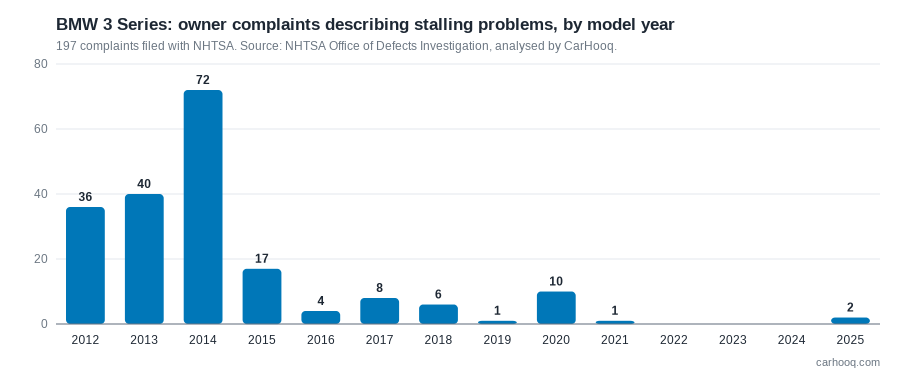
Which BMW 3 Series years have the most stalling complaints?
| Model year | Reports | All complaints | Share |
|---|---|---|---|
| 2025 | 2 | 6 | 33.3% |
| 2024 | 0 | 13 | 0% |
| 2023 | 0 | 14 | 0% |
| 2022 | 0 | 15 | 0% |
| 2021 | 1 | 46 | 2.2% |
| 2020 | 10 | 111 | 9.0% |
| 2019 | 1 | 41 | 2.4% |
| 2018 | 6 | 60 | 10.0% |
| 2017 | 8 | 75 | 10.7% |
| 2016 | 4 | 93 | 4.3% |
| 2015 | 17 | 215 | 7.9% |
| 2014 | 72 | 411 | 17.5% |
| 2013 | 40 | 392 | 10.2% |
| 2012 | 36 | 179 | 20.1% |
The complaints cluster in 2012 to 2014. Together those three years hold 148 of the 197 reports. 2014 is the largest single year, and 2012 has the highest share of its own complaints (20.1%). From 2016 the counts drop to single digits for most years, apart from 2020 with 10. Newer cars have had less time on the road, so the low numbers for 2021 to 2024 do not prove those years are free of the problem. The 33.3% for 2025 is 2 reports out of only 6 complaints, which is too small a sample to read much into.
What do 3 Series owners describe?
The reports do not describe one single event. They describe a car that loses power in different ways, and owners often connect it to different parts. These are the owners' own words, not a diagnosis.
Sudden shut-off with no warning. A 2012 owner wrote: "At no point were there warning lamps, check-engine lights, messages, or reduced-power mode indicators prior to the stalls" (NHTSA complaint 11689232). The same report says "The failure repeated when decelerating on the highway or coming to a stop after exiting." A 2013 owner described "a dramatic power loss with no warning or check engine light" (complaint 11623639).
Shut-off at speed, then no restart. A 2018 owner wrote: "Car just shut off when driving at 65mph and never started back up, took it in and repair was a bad fuel pump and fuel rail line causing metal shards to go through fuel tank and injectors" (complaint 11670096). Fuel-related parts appear often in the data: the Fuel/Propulsion System is named in 56 reports.
Reduced power message and fault codes. A 2015 owner reported a "Reduced Power" message on the dashboard before the engine shut off, and wrote: "After waiting for a few minutes I was able to restart the car and continue travel." A mechanic then found codes including "110001: Cylinder injection shutdown: pressure too low in high pressure system" (complaint 11754958).
Power loss in gear. A 2016 owner wrote: "Throws itself in to neutral while driving" (complaint 11546518). The Power Train is named in 39 reports.
Overheating and cooling parts. A 2014 owner wrote: "out of nowhere I get the Temperature warning and start losing power" (complaint 11722945). A 2019 owner reported that "the Heat Management Module began leaking coolant, posing a significant risk of engine overheating and sudden loss of power while driving" (complaint 11718383). Engine And Engine Cooling is named in 19 reports.
Engine internals. A 2013 owner wrote: "Timing chain guide assembly and oil pump drive chain failed catastrophically" (complaint 11723979).
Of the 197 reports, 7 mention a crash and 4 mention a fire. Across all the reports, 8 people are listed as injured. Many owners describe losing power on a motorway or interstate, which is why the reports read as a safety concern and not just an inconvenience. These are unverified owner statements filed with NHTSA, and NHTSA does not confirm the cause of each one.
Is there a recall for stalling on the 3 Series?
One recall in the data relates to a loss of power on these cars. NHTSA campaign 20V185000 (March 2020) covers certain 2013 to 2016 328d xDrive sedans and 2013 to 2015 328d xDrive station wagons. The recall text says the constant-velocity joint that transfers power between the transfer case and the rear drive shaft "may become damaged, possibly resulting in loss of power to the rear wheels."
The recall states the risk as follows: a loss of power to the rear wheels can affect vehicle control and increase the risk of a crash, and a parked car can roll away if the parking brake is not engaged. The remedy is that dealers replace the constant-velocity joint and inspect the transfer case, replacing it if necessary, free of charge. The recall began May 22, 2020, and BMW customer service is on 1-800-525-7417. The recall does not carry a "do not drive" instruction.
This recall is about loss of drive to the rear wheels. It does not say it covers the fuel pump, engine, cooling or timing chain complaints above, and I would not assume it does. Recalls for other parts may still apply to your car, so check your own VIN. The model report lists the other recalls for the model.
What should you do if your 3 Series stalls or loses power?
I am not a mechanic, so I would stick to steps anyone can take:
- If the car loses power in traffic, put the hazard lights on, steer to a safe place if you can and stop driving. One 2012 owner wrote that power steering was lost along with the engine. Call for help instead of restarting and carrying on.
- Check open recalls for your VIN at the NHTSA recalls page.
- Write down the date, mileage, speed, weather and any warning message on the dash. If a mechanic reads fault codes, ask for the codes in writing.
- Ask a BMW dealer to check for open recalls and any manufacturer service bulletins that apply to your VIN and engine.
- Report the problem at the NHTSA safety problem page. Reports like the ones in this guide are how patterns become visible.
If you are buying a used 3 Series from 2012 to 2014, I would ask for the service history and run the VIN recall check before viewing the car. You can compare years on the report pages, for example 2014 and 2012.
How this guide was made
The numbers come from owner complaints filed with NHTSA. A complaint counts as a stalling report when the owner's text describes the engine stalling, losing power or shutting off while driving. The figures are as of 23 November 2026, and complaints filed after that date are not included. Recall details come from NHTSA recall data. Read more about the method on the methodology page.