Chevrolet Silverado stalling problems: what 1,101 owners reported
Owners have filed 1,101 complaints with NHTSA describing a Chevrolet Silverado that stalls, loses power or shuts off while driving. That is 9.5% of the 11,531 complaints on file for the model. The reports cover model years 2012 to 2026, and the largest group comes from the 2014 truck with 199 reports.
NHTSA lists recalls that mention an engine stall or a loss of drive power for some Silverado trucks: 26V129000 (2025 to 2026 Silverado 3500 with dual fuel tanks), 23V047000 (2017 to 2019 Silverado 2500 and 3500 with a dual fuel tank option) and 24V320000 (2024 Silverado EV). They do not cover every truck, so check your own VIN. If this is not your case, read the full Chevrolet Silverado problem report.
TL;DR
- 1,101 stalling or power loss complaints out of 11,531 for the Silverado (9.5%).
- The most reports come from model years 2014 (199), 2019 (130) and 2021 (114).
- The highest share within a year's complaints is 2026 (20.8%), then 2022 (12.7%) and 2014 (12.3%).
- 20 reports mention a crash and 4 mention a fire. The reports list 6 injuries in total.
- The most named component is Engine (543 reports), then Electrical System (287), Steering (241) and Power Train (240).
- Recalls 26V129000, 23V047000 and 24V320000 mention an engine stall or loss of drive power, but only for specific trucks.
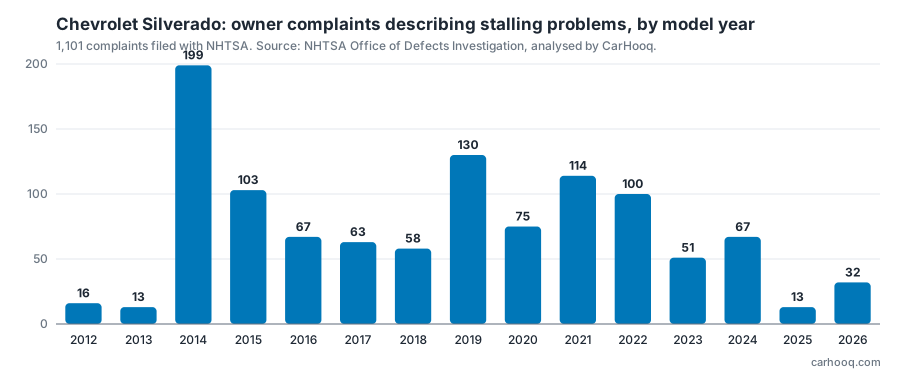
Which Chevrolet Silverado years have the most stalling complaints?
The table counts complaints whose text matches stalling, loss of power or shutting off, next to all NHTSA complaints for that model year. Each year links to its report page.
| Model year | Reports | All complaints | Share |
|---|---|---|---|
| 2026 | 32 | 154 | 20.8% |
| 2025 | 13 | 168 | 7.7% |
| 2024 | 67 | 548 | 12.2% |
| 2023 | 51 | 462 | 11.0% |
| 2022 | 100 | 786 | 12.7% |
| 2021 | 114 | 993 | 11.5% |
| 2020 | 75 | 892 | 8.4% |
| 2019 | 130 | 1,202 | 10.8% |
| 2018 | 58 | 601 | 9.7% |
| 2017 | 63 | 906 | 7.0% |
| 2016 | 67 | 980 | 6.8% |
| 2015 | 103 | 1,424 | 7.2% |
| 2014 | 199 | 1,612 | 12.3% |
| 2013 | 13 | 443 | 2.9% |
| 2012 | 16 | 360 | 4.4% |
Two clusters stand out. The 2014 truck has the most reports by a wide margin, and the 2019 to 2024 trucks together make up a large part of the rest, with shares of 8.4% to 12.7% of each year's complaints. The 2012 and 2013 trucks have few stalling reports (16 and 13), and their share is the lowest in the table. The 2026 share of 20.8% rests on only 32 reports and 154 complaints, because those trucks have had little time on the road, so treat it as early data rather than a verdict.
What do Silverado owners describe?
The complaints are written by owners in their own words, so they describe what the truck did, not why. Nobody here has confirmed a cause, and the groups below are only a way of reading what was filed.
Sudden loss of power at highway speed. This is the most common picture. A 2023 owner wrote: "Was traveling in the left lane on the [XXX] traveling at approx. 75mph at 8PM when I suddenly lost all power to my vehicle. Everything was running fine; there were no warning signs, no sounds, no dash indicators, no nothing." (complaint 11776008). A 2024 owner reported: "While traveling down the road at approx. 65 mph, I lost all power to the truck while towing an empty 3500lb trailer. I was unable to restart vehicle and had to have it towed to a dealership at my expense." (complaint 11769971).
Engine failure after a stall. Some owners say a dealer found the engine had failed. A 2021 owner wrote: "The truck shut down while on the highway, complete loss of power and would not restart. Chevrolet dealership concluded that the engine has locked up/failed." (complaint 11775419). The same owner says Chevrolet told them their 2021 6.2-L L87 engine is not included in Recall 25V-274. That is the owner's statement, and this guide does not check what that recall covers. A 2025 owner described a complete loss of power while pulling a trailer, and said the truck "was diagnosed with engine failure" (complaint 11764033).
Misfire, ticking and collapsed lifters. Several owners tie the stall to the Active Fuel Management system or to valve lifters. A 2015 owner described "loss of power, engine misfire, severe shaking, ticking, check-engine light, stalling, inability to maintain speed" and said a local mechanic "diagnosed the problem as collapsed/failed lifter" (complaint 11764555). A 2016 owner wrote that "The truck engine light came on and was not able to be driven very far without stalling" and that "2 valve lifters were bad" (complaint 11725275). A 2014 owner reported a "severe, loud mechanical ticking noise" followed by "a drastic loss of engine power and violent vehicle shaking" (complaint 11749285). These are what the owners and their mechanics said, not a finding of NHTSA.
Electrical and charging symptoms. The Electrical System is named in 287 reports. A 2018 owner described a battery voltage that "drops down from 14-15v to <= 12v" while turning the wheel, a "Service StabiliTrack" message, and heavy steering, and said "the engine even turned completely off" before "Cycling the key was enough to restart the truck" (complaint 11765250). A 2019 owner reported "repeated Battery Saver warnings, severe charging voltage fluctuations dropping as low as 9 volts, and intermittent reductions in engine power and RPM" (complaint 11775196).
Shifting and throttle complaints. A 2017 owner listed rough shifting and a truck that "stalls at lights runs rough jumps forward has no power at times" and said it had been to the dealership "over 9 times" (complaint 11716571). A 2012 owner reported code P2138 and lost power after the throttle body and accelerator pedal assembly were replaced, with "$3,000 on replacement and labor costs" spent (complaint 11673534).
Across all 1,101 reports, the components named most often are Engine (543), Electrical System (287), Steering (241), Power Train (240), Fuel/Propulsion System (102) and Service Brakes (87). A report can name more than one component, so these counts overlap. Twenty reports mention a crash and four mention a fire, and the reports list 6 injuries in total.
Is there a recall for stalling on the Silverado?
NHTSA data lists three recalls that mention a stall or a loss of drive power on Silverado trucks. Each applies to specific trucks only.
| Campaign | Model years | Defect in the recall text | Fix |
|---|---|---|---|
| 26V129000 | 2025 to 2026 | Silverado 3500 and Sierra 3500 with gasoline engines and dual fuel tanks (RPOs L8T and N2N): the rear fuel pump may not transfer adequate fuel to the front tank, causing an engine stall. | Engine control module (ECM) update by a dealer or over the air, free of charge. |
| 23V047000 | 2017 to 2019 | Silverado 2500 and 3500 with a dual fuel tank option: the rear fuel tank may collapse and prevent the fuel pump from transferring fuel to the front tank, resulting in an engine stall. | Dealers inspect the fuel tank and fuel pump module and replace them as necessary, and add a vent hose to the rear tank assembly, free of charge. |
| 24V320000 | 2024 | Silverado EV and other GM electric vehicles: insufficiently insulated wires in the rear drive unit motors may contact each other, resulting in a loss of drive power. | Dealers replace the rear drive unit, free of charge. |
For 26V129000 and 23V047000, NHTSA states the consequence as "An engine stall increases the risk of a crash." For 24V320000 it is "A loss of drive power increases the risk of a crash." None of the three is flagged "do not drive" in the data.
These recalls name heavy-duty trucks with dual fuel tanks or the electric Silverado EV. Some of the quoted reports above come from 1500 owners, and I would not assume any of these three applies to a 1500 without a VIN check. Other recalls, for parts unrelated to stalling, may still apply to your truck, and one owner above mentions a recall about an alternator connection (19V888) and another about a transmission control valve or sensor. Read the Silverado report page and enter your VIN to see what is open on your own truck.
What should you do if your Silverado stalls or loses power?
I am not a mechanic, and the reports above do not show a single cause, so I would keep to steps that are safe whatever the cause:
- Get to a safe place first. If the truck loses power in traffic, switch on the hazard lights, steer to the shoulder and stop.
- Check open recalls by VIN at nhtsa.gov/recalls. It takes a minute and is free, and it is the only way to know if one of the campaigns above applies to your truck.
- Write it down. Note the date, mileage, speed, whether it was towing, any warning messages (such as Battery Saver or Service StabiliTrack), and what the dash showed. A dated record helps a dealer and helps if you later file a report.
- Ask a dealer to check for open recalls and manufacturer service bulletins that match your symptoms, and ask for the findings in writing.
- Report it at nhtsa.gov/report-a-safety-problem. The complaints in this guide are the reason a pattern is visible at all.
- Stop driving and call for help if the truck loses power again in traffic or the engine makes a loud mechanical noise before the power drops.
If you are buying a used Silverado, look at the report page for the exact model year before you view the truck, for example 2014, 2019 or 2021, and ask the seller for the service history and recall status.
How this guide was made
The numbers come from owner complaints filed with the US National Highway Traffic Safety Administration (NHTSA) and NHTSA recall records, as of 9 November 2026. A complaint counts as a stalling report when its text matches stalling, loss of power or the engine shutting off, so one report can also appear under other topics. Complaints are unverified owner statements, not confirmed defects, and they say nothing about how many trucks were sold. Read more about the method on the methodology page.