Ford Edge engine failure problems: what 672 owners reported
Owners have filed 672 complaints with NHTSA that describe a complete engine failure or a replaced engine on a Ford Edge. That is 7.2% of the 9,284 complaints on file for the model. The reports cluster hard in a few model years: 2017 has 297 of them, 2018 has 185 and 2016 has 113. Together those three years account for 595 of the 672 reports.
Many of the recent reports describe coolant getting into the engine, white exhaust smoke, misfires and a shop or dealer saying the engine needs replacing. One recall exists for engine failure on the Edge, but it covers 2021 and 2022 models with a 2.7L or 3.0L engine, not the years with the most complaints. If this is not your case, read the full Ford Edge problem report.
TL;DR
- 672 reports describe engine failure, 7.2% of the 9,284 Ford Edge complaints on file.
- Most reports by model year: 2017 (297), 2018 (185), 2016 (113), 2019 (31), 2015 (25).
- Highest share of a year's own complaints: 2018 with 185 of 852 (21.7%), then 2017 with 297 of 1,386 (21.4%) and 2016 with 113 of 929 (12.2%).
- 1 report mentions a crash and 1 mentions a fire. The reports list 0 injuries in total.
- Components named most often: Engine (610 reports), Engine And Engine Cooling (76) and Power Train (47).
- Recall 24V635000 (Ford number 24S55) covers 2021-2022 Edge with a 2.7L or 3.0L Nano EcoBoost engine: intake valves may break, causing engine failure and loss of drive power.
- Check your own VIN at the NHTSA recall page before anything else.
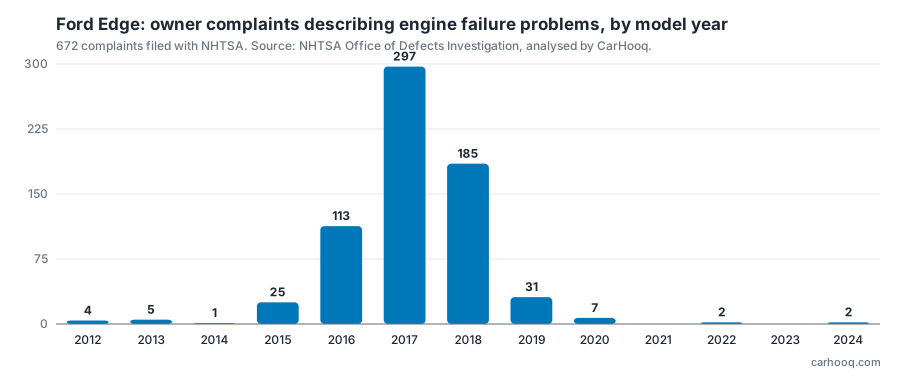
Which Ford Edge years have the most engine failure complaints?
| Model year | Reports | All complaints | Share |
|---|---|---|---|
| 2024 | 2 | 44 | 4.5% |
| 2023 | 0 | 23 | 0.0% |
| 2022 | 2 | 135 | 1.5% |
| 2021 | 0 | 114 | 0.0% |
| 2020 | 7 | 330 | 2.1% |
| 2019 | 31 | 776 | 4.0% |
| 2018 | 185 | 852 | 21.7% |
| 2017 | 297 | 1,386 | 21.4% |
| 2016 | 113 | 929 | 12.2% |
| 2015 | 25 | 731 | 3.4% |
| 2014 | 1 | 383 | 0.3% |
| 2013 | 5 | 2,447 | 0.2% |
| 2012 | 4 | 1,134 | 0.4% |
The pattern is clear: 2016, 2017 and 2018 stand out, and in 2017 and 2018 roughly one complaint in five is about engine failure. The years either side of that block (2015 and 2019) have far fewer. The 2012 to 2014 cars have very few engine failure reports even though 2013 has the most complaints overall (2,447), so their problems lie elsewhere. The 2021 and 2023 model years have no matching reports, but they have also had less time on the road, so a low count there says little.
What do Ford Edge owners describe?
Most of the recent reports describe the same chain of events, and many name the 2.0L EcoBoost engine. These are owners' words, not a confirmed cause.
Overheating and coolant warnings. A 2015 owner wrote that the "Engine Coolant Over Temperature" warning came on and the temperature level spiked while on the highway with children in the car, and that they were "stranded for 4 hours while waiting for a tow" (NHTSA complaint 11770958). A 2016 owner reported "several warnings that my engine coolant is over temperature" and that the car "had shut down several time" (11775569).
White smoke and rough running. A 2019 owner wrote: "Car started running running roughly with white smoke coming out the exhaust." The repair shop said it needed a new engine, and Ford could not help because the car was just out of warranty at 62,000 miles (11772395). A 2017 owner reported a sudden loss of engine power, rough idling and white smoke, with the check engine light showing codes P0301 and P0316 (11775388).
Coolant in the cylinders. Several owners use that phrase. A 2018 owner wrote: "Coolant leak into the cylinders which has caused misfires & overheating. Vehicle no longer starts and has a complete engine failure. not even 75,000 miles have been put on the car" (11774441). Another 2018 owner gave an official repair estimate of $9297.30 at 81,320 miles for a long-block replacement (11773386). A 2016 owner reported the engine "failed due to internal block coolant intrusion, rendering the vehicle completely inoperable at 102,000 miles" (11774837).
Technical service bulletins named by owners. Owners cite Ford TSB 22-2229 (a 2015 and a 2017 report), TSB 19-2346 (2017 and 2018 reports) and TSB 20-2234 for an EGR cooler (a 2020 report, 11769312). I have not seen those bulletins, so treat the numbers as what owners say their dealer referenced. Two owners also say there is an NHTSA investigation into 2015-2018 Edge engines, and a 2019 owner wrote that theirs has "the same engine and had the same issue" (11763042). I cannot confirm any investigation from this data.
A sudden loss of power without warning. A 2022 owner wrote: "Lost power dropped to 65mph without warning. RPM shot up to 4500." They were told the car needed a new engine because of "antifreeze in combustion chamber" (11735315). A 2020 owner reported a sudden loss of power and white or gray smoke, and that no warning lights appeared and the temperature gauge stayed at its normal position (11769312).
Older models and a different engine. A 2013 owner with the 3.5L engine wrote about an internal water pump that failed and leaked coolant, threatening "catastrophic engine failure" (11746866).
The complaints are filed under several components: Engine in 610 reports, Engine And Engine Cooling in 76, Power Train in 47, Fuel/Propulsion System in 15, Electrical System in 10 and Service Brakes in 7. Only 1 report mentions a crash and 1 mentions a fire. Owners who had a loss of power on a highway describe pulling over and waiting for a tow, which is the practical risk here.
Is there a recall for engine failure on the Ford Edge?
Yes, one, but it covers specific cars. Recall 24V635000 was filed on 2024-08-24 for certain 2021-2022 Bronco, F-150, Edge, Explorer, Lincoln Nautilus and Lincoln Aviator vehicles with a 2.7L or 3.0L Nano EcoBoost engine.
- Defect: the engine intake valves may break while driving, which can result in engine failure and a loss of drive power.
- Risk: a loss of drive power increases the risk of a crash.
- Fix: dealers will perform an engine cycle test and replace the engine as necessary, free of charge.
- Owner letters were mailed on July 3, 2025. Ford's number for this recall is 24S55, and owners may contact Ford customer service at 1-866-436-7332.
- The recall does not say to stop driving the vehicle.
This recall does not mention the coolant problems that owners of the 2015 to 2019 cars describe, and I found no recall for that symptom in NHTSA's recall data for these model years as of 9 November 2026. Recalls for other parts may still apply to your Edge, so check by VIN on the NHTSA recalls page. More on the model in the Ford Edge problem report.
What should you do if your Ford Edge has an engine failure or warning?
- Check open recalls for your VIN at nhtsa.gov/recalls. If you have a 2021 or 2022 Edge with a 2.7L or 3.0L engine, look for 24V635000 specifically.
- If a coolant, temperature or check engine warning appears, I would not keep driving. Pull over somewhere safe and call for help. Owners in these reports describe a sudden loss of power on the highway.
- Write down dates, mileage, warning messages, codes and the conditions when it happened (cold start, highway speed). Keep every repair receipt and any case number from Ford: one owner was advised to do exactly that.
- Ask a dealer to check for open recalls and manufacturer service bulletins for your engine and model year.
- Report the problem at nhtsa.gov/report-a-safety-problem. Reports like the ones above are how a pattern becomes visible.
- If you are buying a used 2016 to 2018 Edge, ask for the full service history, including any cooling system work, and check the VIN for open recalls before viewing.
How this guide was made
The numbers come from NHTSA's public owner complaint database. A complaint counts here when its own text describes a complete engine failure or a replaced engine on a Ford Edge. Recalls come from NHTSA's recall data. The data was compiled on 9 November 2026, and later complaints are not included. Quotes are shortened but not reworded, and NHTSA's all-caps text is converted to sentence case. Method details: how the problem reports are built.