Ford Edge overheating problems: what 706 owners reported
Owners have filed 706 NHTSA complaints about the Ford Edge engine overheating or losing coolant, which is 7.6% of the 9,284 complaints on file for the model. The reports cluster in the 2016, 2017 and 2018 model years (613 of the 706), and 2017 alone has 289. Most are filed against the Engine or Engine Cooling components.
NHTSA's recall data for these model years has no recall that matches engine overheating as of 9 November 2026. One 2021 to 2024 recall mentions a module that overheats, but it concerns the rearview camera, not the engine (details below). If this is not your case, read the full Ford Edge problem report.
TL;DR
- 706 complaints mention overheating or coolant loss, 7.6% of all 9,284 Ford Edge complaints.
- The worst years are 2017 (289 reports, 20.9% of that year's complaints), 2018 (200, 23.5%) and 2016 (124, 13.3%).
- Components named most often: Engine (567 reports) and Engine And Engine Cooling (148).
- 2 reports mention a crash, 2 mention a fire, and the reports list 2 injuries in total.
- Several owners say a dealer diagnosed coolant getting into a cylinder and cited Ford Technical Service Bulletin 22-2229.
- The only related recall is 26V124000 (2021 to 2024 Edge), and it covers a rearview camera module, not engine overheating.
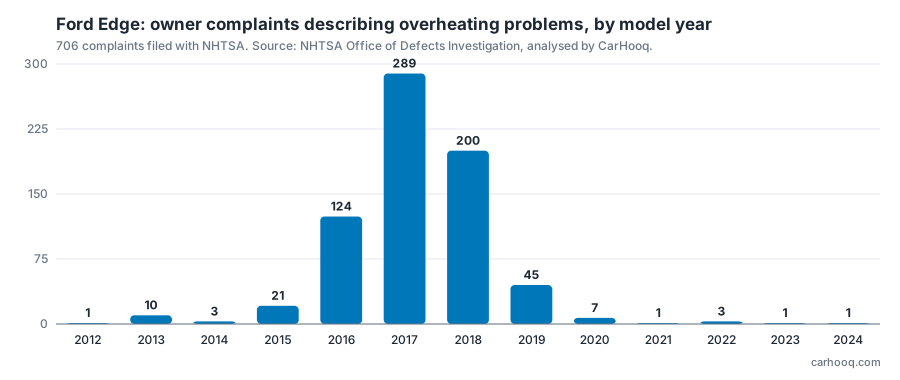
Which Ford Edge years have the most overheating complaints?
| Model year | Reports | All complaints | Share |
|---|---|---|---|
| 2024 | 1 | 44 | 2.3% |
| 2023 | 1 | 23 | 4.3% |
| 2022 | 3 | 135 | 2.2% |
| 2021 | 1 | 114 | 0.9% |
| 2020 | 7 | 330 | 2.1% |
| 2019 | 45 | 776 | 5.8% |
| 2018 | 200 | 852 | 23.5% |
| 2017 | 289 | 1,386 | 20.9% |
| 2016 | 124 | 929 | 13.3% |
| 2015 | 21 | 731 | 2.9% |
| 2014 | 3 | 383 | 0.8% |
| 2013 | 10 | 2,447 | 0.4% |
| 2012 | 1 | 1,134 | 0.1% |
The pattern is sharp. Between 2016 and 2018, between roughly one in seven and one in four of each year's complaints is about overheating or coolant loss. The 2013 and 2012 years have far more complaints overall (2,447 and 1,134) but almost none about overheating, so their problems are mostly elsewhere. From 2019 the numbers drop quickly. Newer cars have had less time on the road, so a low count for 2021 to 2024 does not show those years are free of the problem.
What do Ford Edge owners describe?
Coolant getting into a cylinder. This is the most repeated description in the recent complaints. A 2017 owner describes "recurring overheating problems, including at highway speeds" and "suspected coolant intrusion into the engine, a condition addressed in Ford Technical Service Bulletin 22-2229" (complaint 11775957). A 2018 owner reports that a dealer gave "a service report stating the engine needs to be replaced per tsb22-2229 coolant leaking into cylinders" (complaint 11775940). Another 2017 owner writes: "Vehicle was using coolant, engine overheating warning, whole vehicle violently shaking, could not accelerate/loss of power, got diagnosed with coolant intrusion on cylinder 1" (complaint 11775618). A 2015 owner says "I got engine coolant leaking into cylinder #2 with error p0302" and that the car "will not accelerate" (complaint 11770648).
Warnings, shutdowns and smoke. A 2016 owner reports "several warnings that my engine coolant is over temperature" and that the car "had shut down several time", followed by "white exhaust smoke, severe engine misfires, and persistent overheating" (complaint 11775569).
Loss of power without a warning. A 2020 owner says the EGR cooler failed (citing TSB 20-2234) and that the car had "a sudden loss of power while driving", while the "temperature gauge remained at it's normal operating temp, dead center" (complaint 11769312). That is worth knowing: a normal gauge reading is not proof that nothing is wrong with the cooling system.
Water pump. A 2013 owner with the 3.5L engine reports that "the internal water pump has failed, leaking green coolant onto the ground" (complaint 11746866).
Some complaints that match the word "overheating" are about other parts: a phone charger or the centre display overheating (for example complaint 11731785 for a 2022 and complaint 11760345 for a 2023), and a transmission torque converter on a 2019 (complaint 11765467). They are in the 706 count, so the real number of engine cooling reports is somewhat lower. The components NHTSA lists for the reports also include Power Train (68), Fuel/Propulsion System (18), Electrical System (13) and Service Brakes (9).
These are owner statements, not confirmed diagnoses. Complaints often repeat what a dealer or a web search told the owner, and I cannot verify them.
Is there a recall for overheating on the Ford Edge?
NHTSA's recall data for these model years has no recall matching engine overheating or coolant loss as of the brief date of 9 November 2026. Recalls for other parts may still apply to your car, so check your VIN.
One recall does use the word. Campaign 26V124000 (dated 4 March 2026) covers certain 2021 to 2026 Ford Bronco and 2021 to 2024 Ford Edge vehicles. Per the recall text, the Accessory Protocol Interface Module (APIM) "may overheat and shutdown, which can prevent the rearview camera image from displaying as intended." The stated risk is a reduced view behind the vehicle. The remedy is an APIM software update by a dealer or over the air, free of charge. Ford's number for it is 26S09, and the owner line is 1-866-436-7332. It is not a recall for engine overheating and says nothing about coolant.
What should you do if your Ford Edge overheats?
- If the temperature warning appears or the car loses power in traffic, stop driving when it is safe and call for help. Do not keep driving an overheating engine.
- Check open recalls for your VIN at nhtsa.gov/recalls.
- Write down the dates, mileage, warning messages and conditions (cold start, highway speed, after stopping), plus any coolant top-ups you had to make.
- Ask a dealer to check for open recalls and manufacturer service bulletins for your VIN. I would ask specifically whether TSB 22-2229 or TSB 20-2234, which owners cite, applies to your engine. I cannot say from this data whether they do.
- Report the problem at nhtsa.gov/report-a-safety-problem. Reports are how patterns like the one above become visible.
If you are buying a 2016 to 2018 Edge, I would ask for the coolant service history and have it inspected before agreeing a price. Browse the report pages for individual years, such as 2017 and 2018, for the other problems owners report.
How this guide was made
The data comes from the NHTSA complaints and recalls databases. Complaints were matched to this symptom by searching the owners' own complaint text for overheating and coolant loss, then grouped by model year. The figures are as of 9 November 2026. See the methodology for how matching and counting work.