Ford Escape check engine light problems: what 2,384 owners reported
Owners filed 2,384 NHTSA complaints that mention the check engine light on the Ford Escape. That is 15.2% of the 15,730 complaints on file for the model. The complaints span model years 2012 to 2025, but they cluster heavily in the 2017 and 2018 Escape.
A lit check engine light is a warning, not a diagnosis. In these reports it is often described next to an overheating message, lost coolant, reduced power or a stall, and NHTSA's recall data for these model years has no recall matching this symptom as of 28 October 2026. If this is not your case, read the full Ford Escape problem report.
TL;DR
- 2,384 complaints mention the check engine light, 15.2% of all 15,730 Escape complaints.
- 2017 has the most reports (881), then 2018 (579) and 2013 (263).
- 2017, 2018 and 2019 together account for 1,621 of the 2,384 reports.
- The complaints name the engine most often: 1,526 list "Engine" and 744 list "Engine And Engine Cooling".
- Four reports mention a crash and 20 mention a fire. The reports list 5 injuries in total.
- No recall in NHTSA's data for these model years matches this problem.
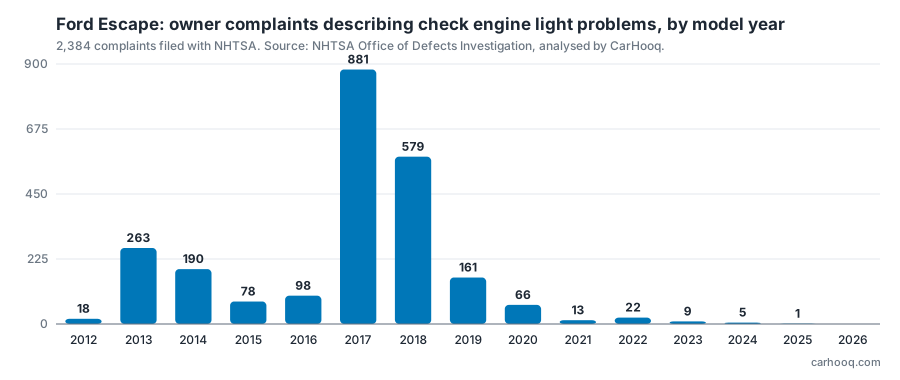
Which Ford Escape years have the most check engine light complaints?
| Model year | Reports | All complaints | Share |
|---|---|---|---|
| 2026 | 0 | 4 | 0.0% |
| 2025 | 1 | 31 | 3.2% |
| 2024 | 5 | 88 | 5.7% |
| 2023 | 9 | 138 | 6.5% |
| 2022 | 22 | 384 | 5.7% |
| 2021 | 13 | 381 | 3.4% |
| 2020 | 66 | 1,834 | 3.6% |
| 2019 | 161 | 596 | 27.0% |
| 2018 | 579 | 1,817 | 31.9% |
| 2017 | 881 | 2,698 | 32.7% |
| 2016 | 98 | 1,165 | 8.4% |
| 2015 | 78 | 1,129 | 6.9% |
| 2014 | 190 | 2,089 | 9.1% |
| 2013 | 263 | 2,757 | 9.5% |
| 2012 | 18 | 619 | 2.9% |
In 2017, 2018 and 2019 about a quarter to a third of all complaints mention the light, while in most other years the share is under 10%. The 2013 and 2014 models form a smaller second group, with 263 and 190 reports. The newest years, 2023 to 2026, have few reports, but those cars have had less time on the road and fewer owners have filed complaints yet, so a low count there says little.
What do Escape owners describe?
Most of the quotes below come from owners who describe the light arriving together with something else, usually heat or coolant. They are owner statements filed with NHTSA, not confirmed diagnoses.
Overheating and coolant loss. This is the most common pairing in the sample. A 2015 owner wrote: "Last Friday I was driving my car and my temperature gauge went to Hot and my Check Engine Light came on" (complaint 11756661). A 2014 owner described that "my engine suddenly got hot and the engine light came on and I got a coolant alert. All my coolant was gone" (11742948). A 2025 owner reported that "while driving 65 MPH, the message that the engine was overheating was displayed, and the vehicle drove under reduced power" and that the check engine light came on afterwards (11752454).
Coolant reaching the engine. Several owners say a shop or dealer told them coolant was getting inside. A 2019 owner wrote that "the check engine light has repeatedly came on and been brought to the mechanics numerous times throughout the year" and that the cause "is due to engine coolant leaking into the engine" (11768729). A 2018 owner reported that "my 2018 Ford Escape 1.5 liter Ecoboost engine has a known flaw of coolant intrusion into the cylinders" and that Ford service said it needs a new engine (11772509). A 2017 owner wrote that the dealership "reported that the head gasket had blown, the engine had cracked" and quoted "$10,000 for a new engine and replacement" (11772811).
Hose and fuel line failures. A 2016 owner wrote that the light came on and "appeared that coolant hose popped off", after which the dealer "replaced thermostat housing, coolant crossover and heater core hoses, replaced degas bottle hose" (11768765). A 2013 owner reported that a technician "confirmed both the Fuel Line had ruptured and was actively dripping into Engine Bay" (11767334).
Loss of power and stalling. A 2012 owner wrote of a "single code P2111 occurring after reduction of power" and that the "vehicle looses power at varying speeds including highway speeds" (11767730). A 2024 owner said the car "died and shut off in the middle of a busy intersection at a red light", and that the dealership reported the "crank shaft sensor and the PCM weren't allowing proper engine control" (11647511).
Transmission and hybrid reports. A 2020 owner reported "severe Shuddering in and out of Lockup" with the check engine light on intermittently and an estimate of "$11,321.25" (11756281). A 2022 Escape Hybrid owner wrote that "a wrench icon and check engine light illuminated on the dashboard" and the car "dropped into a low-speed mode" (11764780). That owner also refers to Customer Satisfaction Program 23N06, which I have not been able to confirm here, so ask a dealer about it by VIN.
Across all 2,384 reports, the components named are Engine (1,526), Engine And Engine Cooling (744), Power Train (265), Fuel/Propulsion System (107), Electrical System (90) and Fuel System (82). Twenty reports mention a fire and four mention a crash, and the reports list 5 injuries in total.
Is there a recall for the check engine light on the Escape?
NHTSA's recall data for these model years has no recall matching this problem as of 27 October 2026. That does not mean no recall applies to your car. Recalls for other parts may still be open, and the check engine light can have many causes. Recall status is tied to the VIN, so check yours at nhtsa.gov/recalls. The Ford Escape problem report lists the recalls NHTSA has on file for the model.
What should you do if your Escape check engine light comes on?
- If the light is on together with an overheating message, a reduced power message or a loss of power, I would not keep driving. Pull over safely and call for help. Two owners above were told not to drive the car.
- Write down the date, mileage, any warning messages and what the car was doing: speed, cold start, idling, refuelling.
- Check open recalls by VIN at nhtsa.gov/recalls.
- Ask a dealer to read the stored fault codes and to check for open recalls and manufacturer service bulletins for your VIN.
- If the problem looks like a safety defect, report it at nhtsa.gov/report-a-safety-problem. Complaints are how the numbers in this guide come about.
I am not a mechanic, and a lit check engine light on its own does not tell you what is wrong. Only a scan of the codes and an inspection can do that.
How this guide was made
The data comes from NHTSA's public consumer complaint database. Complaints were included when the owner's text matched the check engine light symptom, and the figures are as of 27 October 2026. The method is explained in the data methodology.