Ford Escape engine failure problems: what 1,360 owners reported
Owners have filed 1,360 complaints with NHTSA describing a Ford Escape with a failed engine or an engine that had to be replaced. That is 8.6% of the 15,730 complaints on file for the model. The reports cover model years 2013 to 2025, and two clusters stand out: 2017 and 2018 together account for 967 of them.
NHTSA's recall data lists four engine recalls that name an engine failure or engine damage on the Escape: one for 2021 Escape Hybrids and three for 2020 to 2023 models with 2.5L hybrid or plug-in hybrid engines. Whether one applies to a particular car depends on its VIN. If this is not your case, read the full Ford Escape problem report.
TL;DR
- 1,360 reports describe engine failure or a replaced engine, 8.6% of the 15,730 Escape complaints.
- 2017 has 546 reports (20.2% of that year's complaints), 2018 has 421 (23.2%) and 2019 has 116 (19.5%).
- 23 reports mention a fire and 2 mention a crash. The reports list 6 injured people in total.
- The component field most often says Engine (1,200 reports), then Engine And Engine Cooling (166) and Power Train (130).
- Four recalls: 22V109000 (2021 Escape Hybrid), 22V484000, 23V380000 and 25V345000 (2020 to 2023, 2.5L hybrid and plug-in hybrid).
- Several of the quoted reports mention coolant in the engine and dealer estimates for an engine replacement, such as $10,000 and $8,300.
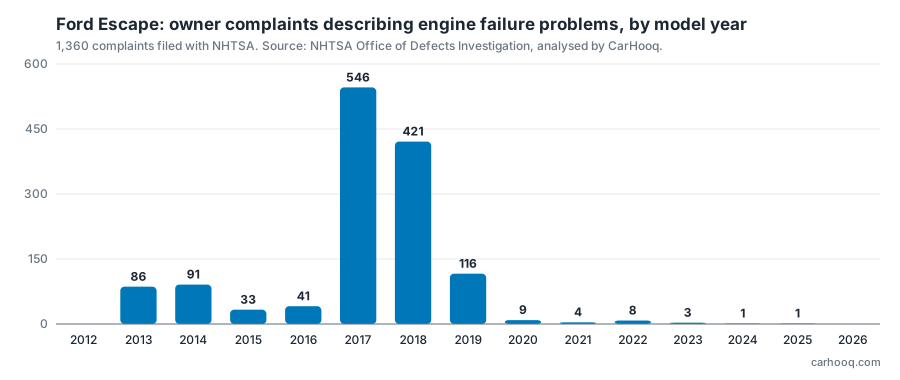
Which Ford Escape years have the most engine failure complaints?
| Model year | Reports | All complaints | Share |
|---|---|---|---|
| 2025 | 1 | 31 | 3.2% |
| 2024 | 1 | 88 | 1.1% |
| 2023 | 3 | 138 | 2.2% |
| 2022 | 8 | 384 | 2.1% |
| 2021 | 4 | 381 | 1.0% |
| 2020 | 9 | 1,834 | 0.5% |
| 2019 | 116 | 596 | 19.5% |
| 2018 | 421 | 1,817 | 23.2% |
| 2017 | 546 | 2,698 | 20.2% |
| 2016 | 41 | 1,165 | 3.5% |
| 2015 | 33 | 1,129 | 2.9% |
| 2014 | 91 | 2,089 | 4.4% |
| 2013 | 86 | 2,757 | 3.1% |
The 2017, 2018 and 2019 model years stand apart: in each, roughly one complaint in five is about engine failure, against 8.6% for the model overall. The 2018 year has the highest share (23.2%) and 2017 has the most reports (546). Model years 2013 and 2014 have a smaller but visible group of 86 and 91 reports. The 2020 to 2025 years have few reports, which is partly because those cars have had less time on the road, and the engine recalls for 2020 to 2023 cars are covered below.
What do Ford Escape owners describe?
Most of the descriptions are about coolant and overheating before the engine failed. Where owners name a cause, they are repeating what a dealer or mechanic told them, and I am not able to confirm any of it. Here is what the reports say.
Overheating warnings, then a dealer diagnosis. A 2017 owner wrote: "When driving home my usual 5 miles from work, the car gave me a signal that it overheated and I should pull over immediately." Later, "When I brought it into The Ford dealership, they reported that the head gasket had blown, the engine had cracked, and it was leaking coolant into other areas of the car." They were quoted "$10,000 for a new engine and replacement" (complaint 11772811).
Coolant intrusion. Another 2017 owner reported that "They told us there was coolant intrusion in the engine, and that the car was unsafe to drive and required a new engine." The car had 46,000 miles and the owner took "a payout of only $1,500" (complaint 11771788). A 2019 owner wrote that the dealership "diagnosed coolant intrusion requiring replacement of major short block components (est. $8,300)" at 43,379 miles (complaint 11770414). A 2014 owner wrote: "Coolant leak into the cylinder causing engine failure and need to replace the engine, it is not possible to fix this, must replace engine." (complaint 11753420).
Slow coolant loss and smoke on startup. A 2013 owner described "excessive visible smoke/steam on startup and coolant consumption" at about 95,000 miles. The owner said it was inspected by a Ford dealer and private party mechanics but "could not be accurately diagnosed without engine disassembly", and that "No evidence of external coolant leaks were present" (complaint 11748003).
A repeat failure. A 2016 owner wrote: "Replaced engine, and two years later facing identical issue with another engine failure. Unidentifiable coolant leak led to low oil pressure and car shaking on the highway." (complaint 11763110).
Failure on the road. A 2015 owner reported that "my engine totally overheated requiring I drift into an isolated parking area", and that the coolant "had totally run dry" (complaint 11758449). A 2024 owner described "onset of engine sounds then louder With grinding noises, loss of power and cessation" and being "stranded In the mountains" (complaint 11632556).
Hybrid models and fire. A 2022 Escape HEV owner wrote: "On 20 July 2026, my 2022 Ford Escape HEV caught fire in the engine compartment while parked." (complaint 11752612). A 2020 owner reported that the car "shut down from a new engine block recall or mandate" and "Has been in the shop for four months" (complaint 11720604). A 2021 owner wrote about an open recall that "has remained open for more than one year, yet no remedy has been made available" (complaint 11751782).
Across all 1,360 reports, 23 mention a fire and 2 mention a crash, and the reports list 6 injured people in total. The component field is mostly Engine (1,200 reports), with Engine And Engine Cooling (166), Power Train (130), Fuel/Propulsion System (53), Electrical System (35) and Service Brakes (12) also named. A report can name more than one component.
Is there a recall for engine failure on the Escape?
Yes, for some model years. NHTSA's recall data lists four campaigns that name an engine failure or engine damage:
| Campaign | Date | Model years | Defect as stated by NHTSA |
|---|---|---|---|
| 22V109000 | 2022-02-24 | 2021 Escape Hybrid | The engine crankshaft may have been manufactured incorrectly, which can result in engine damage. |
| 22V484000 | 2022-07-07 | 2020 to 2022 | 2.5L HEV or PHEV engines: in the event of an engine failure, engine oil and fuel vapor may be released and accumulate near ignition sources, possibly resulting in an engine compartment fire. |
| 23V380000 | 2023-05-26 | 2020 to 2023 | Same defect statement, for 2.5L HEV or PHEV engines. |
| 25V345000 | 2025-05-23 | 2020 to 2023 | Same defect statement, for vehicles repaired incorrectly under recall 23V380. |
The consequence for 22V109000 is that engine damage "can cause a vehicle stall or fire, increasing the risk of a crash or injury". For the other three it is that an engine compartment fire increases the risk of injury. The remedies differ:
- 22V109000: dealers inspect the crankshaft and replace the engine, as necessary, free of charge. Ford's number for this recall is 22S10.
- 22V484000: dealers modify the under engine shield and active grille shutter, free of charge.
- 23V380000: dealers replace the engine long-block in 2023 Escape and Corsair vehicles. For the other vehicles, dealers update the powertrain control module software.
- 25V345000: dealers update the powertrain control module software, free of charge. Ford's number for this recall is 25S54.
For the three fire-related campaigns, the owner advice is to park and shut off the engine as quickly as possible if you hear unexpected engine noises, notice a reduction in vehicle power, or see smoke. Ford customer service is on 1-866-436-7332, as stated in the recalls.
These recalls cover 2.5L hybrid and plug-in hybrid engines in 2020 to 2023 cars and the 2021 hybrid crankshaft. NHTSA's recall data for the other model years in the table has no recall matching the coolant-related engine failures described above as of the brief date, and I would not assume the recalls above apply to a 2017 or 2018 car. Recalls for other parts may still apply, so check your VIN.
What should you do if your Escape engine fails?
- Stop driving and call for help if the engine overheats, loses power or makes grinding noises, especially in traffic. If you see smoke, park and shut the engine off, as the recalls advise.
- Check open recalls for your exact car by VIN at NHTSA recalls.
- Write down dates, mileage, warning messages, coolant top-ups and the conditions when it happened.
- Ask a dealer to check for open recalls and manufacturer service bulletins for your VIN, and ask for any diagnosis in writing.
- Report the problem at NHTSA report a safety problem.
I am not a mechanic and I would not guess at a cause from outside the car. The complaints show what owners were told, not a confirmed cause for every car.
If you are looking at a used Escape, compare the model years above and check the VIN first. I would also read the 2017 and 2018 report pages before buying one of those years.
How this guide was made
The numbers come from NHTSA's public complaints and recalls database. Reports were found by matching owner complaint text to engine failure or a replaced engine, then counted by model year, and the brief behind this guide is dated 2026-10-27. Quotes are exactly as owners wrote them, with some shortened. The full method is on the methodology page.