Ford Escape overheating problems: what 2,293 owners reported
Owners have filed 2,293 complaints with NHTSA about the Ford Escape engine overheating or losing coolant. That is 14.6% of the 15,730 complaints on file for the model. The reports cover model years 2012 to 2026, but they cluster heavily on the 2013, 2014, 2017 and 2018 Escape.
Ford has issued several recalls that mention overheating or coolant loss on specific Escape engines, mostly the 1.6L engine in the 2013 and 2014 models. If this is not your case, read the full Ford Escape problem report.
TL;DR
- 2,293 overheating and coolant-loss complaints, 14.6% of all 15,730 Ford Escape complaints.
- Most reports: 2017 (617), 2013 (530), 2018 (491) and 2014 (346).
- 49 reports mention a fire and 2 mention a crash. The reports list 11 injuries in total.
- Components named most often: Engine (1,774 reports), Engine And Engine Cooling (475) and Power Train (199).
- Recalls that mention overheating or coolant loss: 12V431000, 12V551000 and 13V583000 (2013 Escape, 1.6L), and 17V209000 (2014 Escape, 1.6L).
- Recalls 25V343000, 25V685000 and 26V011000 concern engine block heaters, which can crack, leak coolant or overheat when plugged in.
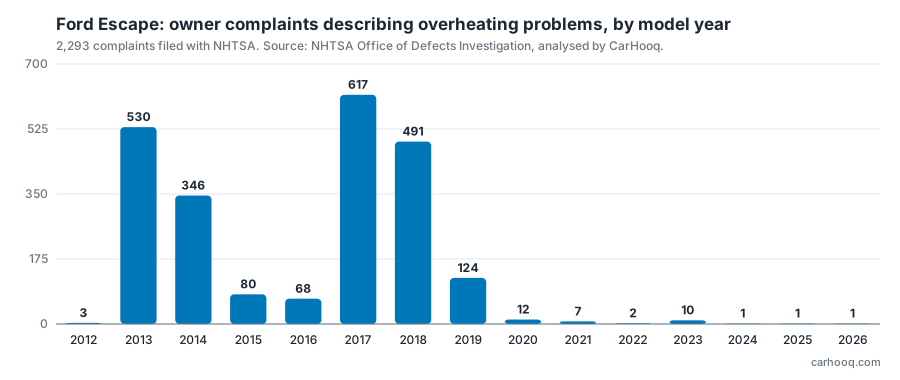
Which Ford Escape years have the most overheating complaints?
| Model year | Reports | All complaints | Share |
|---|---|---|---|
| 2026 | 1 | 4 | 25.0% |
| 2025 | 1 | 31 | 3.2% |
| 2024 | 1 | 88 | 1.1% |
| 2023 | 10 | 138 | 7.2% |
| 2022 | 2 | 384 | 0.5% |
| 2021 | 7 | 381 | 1.8% |
| 2020 | 12 | 1,834 | 0.7% |
| 2019 | 124 | 596 | 20.8% |
| 2018 | 491 | 1,817 | 27.0% |
| 2017 | 617 | 2,698 | 22.9% |
| 2016 | 68 | 1,165 | 5.8% |
| 2015 | 80 | 1,129 | 7.1% |
| 2014 | 346 | 2,089 | 16.6% |
| 2013 | 530 | 2,757 | 19.2% |
| 2012 | 3 | 619 | 0.5% |
There are two clear clusters: 2013 and 2014, then 2017 to 2019. In 2018, 27.0% of all complaints are about overheating, the highest share among the years with a large number of complaints. The 2026 share of 25.0% is one report out of four, so it says very little. Newer years have fewer reports partly because those cars have had less time on the road.
What do Ford Escape owners describe?
A warning, then a stop. Owners describe an overheating message on the dash and the car slowing down. A 2016 owner wrote: "Vehicle displayed warning that it was overheating and automatically slowed to lower speed" (NHTSA complaint 11768763). The dealer in that case "determined a turbocharger wastegate solenoid internal failure". A 2023 owner wrote that "After accelerating my engine coolant overheat warning light goes off and i can't accelerate any further until light goes off" (11669577), and that a Ford mechanic mentioned "metal shavings in the coolant".
Coolant running dry. A 2015 owner wrote: "my engine totally overheated requiring I drift into an isolated parking area" and that "the coolant had totally run dry" (11758449). A 2019 owner with about 39,000 miles described repeated check-engine lights, then "overheating warnings and repeatedly losing coolant", and said the coolant reservoir "was found completely empty" on one occasion (11768983).
Coolant inside the engine. Several owners of 1.5L and 1.6L EcoBoost cars use the term coolant intrusion. A 2013 owner wrote that "Professional mechanical diagnostics have explicitly confirmed that engine coolant is pooling on top of piston #2" and also described "unexplained coolant loss with no external leaks" (11751203). A 2018 owner wrote that "a coolant leak was reported by two mechanics but the source of the leak couldn't be identified" (11772621).
Head gasket and engine damage. A 2017 owner wrote that the dealer reported "the head gasket had blown, the engine had cracked", and quoted "$10,000 for a new engine" (11772811). These are one owner's account of what a dealer said, not a finding that applies to every Escape.
Remote start. A 2014 owner wrote: "when the remote start is activated. The car will show as overheating", with "over 1900 in towing and repairs" and the problem returning "4 weeks later" (11765816).
Cost and warranty. A 2022 owner wrote about an "Egr coolant leak" in the first 70,000 miles, found "when the part is no longer covered by warranty" (11639693).
Most reports name the engine as the component. Fire is mentioned in 49 reports and a crash in 2.
Is there a recall for overheating on the Escape?
Yes, for specific engines and years. These are the campaigns in NHTSA's data that match this problem:
| Campaign | Escape years | What the recall says |
|---|---|---|
| 12V431000 | 2013 (1.6L) | Cylinder head cup plug (freeze plug) may become dislodged, causing significant coolant loss. Fix: seal the plug and add a secondary plug cover. |
| 12V551000 | 2013 (1.6L) | Coolant system leaks may cause engines to overheat and leak flammable fluids. Fix: dealers inspect for leaks and reprogram the powertrain control module and instrument cluster with updated overheat strategy software. |
| 13V583000 | 2013 (1.6L) | Localized overheating of the cylinder head may cause cracks that allow oil to leak. Fix: dealers modify engine shielding, cooling and control systems. |
| 17V209000 | 2014 (1.6L GTDI) | Driving with insufficient coolant may overheat and crack the cylinder head. Fix: dealers install a coolant level sensor and supporting hardware and software. |
All four recalls state a fire risk and none carries a "do not drive" instruction in the data. Owners can call Ford customer service at 1-866-436-7332 for 13V583000, 12V431000 and 17V209000.
Three more recalls mention an engine block heater, a heater used in cold climates:
- 25V343000 (2025): certain 2023 to 2025 Escape vehicles with a 1.5L or 2.0L engine and a block heater. The block heater may overheat when plugged in, which can increase the risk of a fire.
- 25V685000 (2025): the block heater may crack and develop a coolant leak, causing a short circuit when plugged in. NHTSA's data matches it to Escape model years 2020 to 2022.
- 26V011000 (2026): the same defect on certain 2013 to 2019 Escape vehicles with a 2.0L engine. Owners are advised not to plug in their block heater until the vehicle is remedied.
Recalls for other parts may also apply to your car. Check your VIN rather than relying on this list.
What should you do if your Escape overheats?
- If the temperature warning appears, pull over safely and stop. If the car loses power in traffic, stop driving and call for help rather than carrying on.
- Check your VIN for open recalls at the NHTSA recalls page.
- Write down the date, mileage, warning messages and conditions (cold start, highway, remote start, after adding coolant).
- Ask a dealer to check for open recalls and manufacturer service bulletins that match your engine and year.
- Report the problem at NHTSA's safety problem page. Reports are how patterns like the ones above become visible.
I am not a mechanic, so I would not guess at the cause from a warning light alone. The VIN check is free and takes a few minutes. You can also browse other years in the Ford Escape model year reports or the problem lookup.
How this guide was made
The numbers come from owner complaints filed with NHTSA and from NHTSA recall records, as of 2026-10-27. Complaints were matched to this symptom by the owner's description of overheating or coolant loss, so a few matches are about other parts that overheated. The method is explained on the methodology page. A complaint is one owner's account and is not a confirmed defect.