Ford Escape rough idle and misfire problems: what 1,588 owners reported
Owners have filed 1,588 complaints with NHTSA about rough idling, misfires or hesitation when accelerating on the Ford Escape. That is 10% of the 15,804 complaints on file for the model. The reports cover model years 2012 to 2025, and they cluster heavily in 2017 and 2018.
NHTSA's recall data in this dataset has no recall matching this symptom as of 9 November 2026. Several owners describe coolant reaching a cylinder together with misfire codes, and one 2020 owner cites a recall number that I could not match in the data. If this is not your case, read the full Ford Escape problem report.
TL;DR
- 1,588 reports of rough idle, misfire or hesitation, 10% of the 15,804 Escape complaints.
- The worst model years are 2017 (561 reports), 2018 (424) and 2013 (162).
- 2017 and 2018 also have the highest share of their own complaints on this symptom: 21% and 23%.
- 2 reports mention a crash and 5 mention a fire. The reports list 2 injuries in total.
- Components named most often: Engine (1,092), Engine And Engine Cooling (304), Power Train (296) and Fuel/Propulsion System (111).
- No recall matching this symptom is listed for these model years in the data used here.
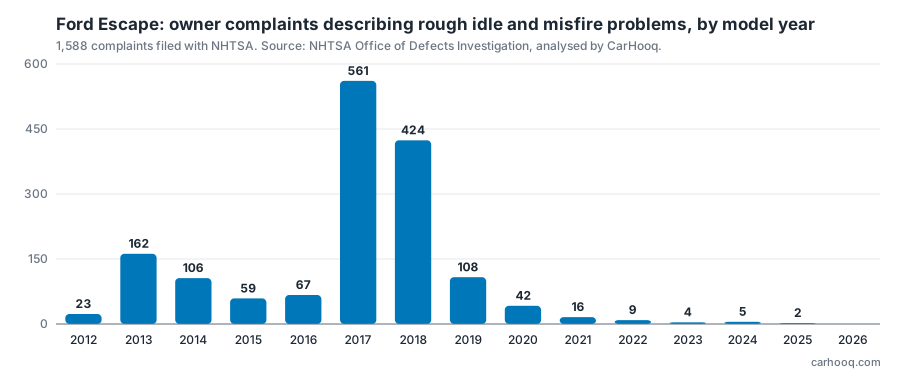
Which Ford Escape years have the most rough idle complaints?
| Model year | Reports | All complaints | Share |
|---|---|---|---|
| 2026 | 0 | 4 | 0% |
| 2025 | 2 | 31 | 6% |
| 2024 | 5 | 90 | 6% |
| 2023 | 4 | 139 | 3% |
| 2022 | 9 | 388 | 2% |
| 2021 | 16 | 385 | 4% |
| 2020 | 42 | 1,841 | 2% |
| 2019 | 108 | 602 | 18% |
| 2018 | 424 | 1,825 | 23% |
| 2017 | 561 | 2,705 | 21% |
| 2016 | 67 | 1,186 | 6% |
| 2015 | 59 | 1,142 | 5% |
| 2014 | 106 | 2,090 | 5% |
| 2013 | 162 | 2,757 | 6% |
| 2012 | 23 | 619 | 4% |
Three model years, 2017, 2018 and 2019, account for 1,093 of the 1,588 reports. In those years roughly one complaint in five is about this symptom, against 2% to 6% for most other years. The 2013 and 2014 years form a smaller cluster. Model years 2023 to 2026 have few reports, which partly reflects less time on the road and fewer filings so far.
What do Escape owners describe?
Misfire codes on one cylinder, often after parts were replaced. A 2016 owner wrote: "We've been having check engine light on "Cylinder 2 misfire". We had the spark plugs replaced and the ignition coil replaced, which fixed it for about a month, but it returned." (NHTSA complaint 11774939). A 2018 owner reported: "Id been getting misfires on cylinder 3 and eventually 2 even after replacing coilpacks, spark plugs, and fuel injectors" (11775320).
Coolant found in the cylinders. This theme appears in six of the quotes I selected. A 2015 owner wrote: "I have coolant intrusion into cylinder 3, pressure in the coolant tank, white smoke from the exhaust." They add that the dealer's diagnostic said the engine needs replacing (11749149). A 2013 owner reported that "Professional mechanical diagnostics have explicitly confirmed that engine coolant is pooling on top of piston #2" (11751203). These are owners' own accounts and the diagnoses they were given, not a finding by NHTSA.
Overheating and coolant loss alongside misfires. A 2019 owner with about 39,000 miles wrote that the car "developed repeated check-engine lights, misfires, and severe shaking while driving" and later showed overheating warnings and repeated coolant loss (11768983).
Turbocharger problems. A 2014 owner wrote: "At the same time, my idling was excessively rough and felt dangerous to drive" after a turbocharger was diagnosed as damaged (11741537). A 2023 owner says the dealership found a failed turbocharger wastegate valve, with "hesitation, rough shifting, delayed upshifts" (11748002).
Hesitation and power loss on newer cars. A 2020 owner described "sudden, uncommanded loss of power, severe engine hesitation and violent stuttering during acceleration" (11772385). A 2025 owner was warned of an EGR valve issue and wrote that "the car started misfiring and sporadically moving" before dying at a stop light (11748056).
Some complaints in this group describe a transmission rather than the engine. A 2022 owner wrote that the "Transmission shudders and hesitates during low-speed operation, typically around 10-15 mph" (11747565). Complaint text is matched to the symptom automatically, so a few reports are only loosely related.
Is there a recall for rough idle on the Escape?
The recall data used for this guide has no recall matching this symptom for the model years above as of 9 November 2026. Recalls for other parts may still apply to your car, so check by VIN.
One 2020 owner wrote that a service center told them the problem was "a recall - NHTSA - 25V467 recall 25S76 (engine hesitant acceleration, rough idling, reduced engine power)" and that the dealer said the program had been paused (11772385). I could not confirm that campaign in the data behind this guide, so treat it as the owner's account and check your VIN directly. A 2021 owner likewise complained about a recall that had stayed open for more than a year with no remedy (11751782).
What should you do if your Escape idles rough or misfires?
- Check open recalls for your VIN at nhtsa.gov/recalls. I would do this first.
- Write down the date, mileage, warning messages and the conditions: cold start, idle, acceleration or highway.
- Ask a dealer to check for open recalls and manufacturer service bulletins for your VIN, and ask for any diagnosis in writing.
- If the car shows overheating warnings, loses coolant or smokes, do not keep driving it.
- If it loses power in traffic, stop somewhere safe and call for help.
- Report the problem at nhtsa.gov/report-a-safety-problem. Each report adds to the record other owners and buyers see.
I am not a mechanic and this guide does not diagnose your car. It only shows what other owners reported.
How this guide was made
The data comes from owner complaints filed with NHTSA, matched to this symptom by the text of each complaint, with data as of 9 November 2026. The counts are reports, not confirmed defects, and a car with more owners will have more complaints. Details are in the methodology. You can also browse the Car Problem Lookup.