Ford Escape stalling problems: what 1,966 owners reported
Owners of the Ford Escape have filed 1,966 NHTSA complaints about the engine stalling, losing power or shutting off while driving. That is 12.4% of the 15,815 complaints filed for the model. Reports span the 2012 to 2025 model years, and the 2013 Escape alone accounts for 676 of them.
NHTSA's recall data lists six recalls that mention a loss of drive power or an engine stall on certain Escapes, mostly 2020 to 2022 hybrids and 2021 models. Many other complaints describe engine problems, coolant leaks and misfires, and no recall in the data covers those. If this is not your case, read the full Ford Escape problem report.
TL;DR
- 1,966 stalling and power loss complaints, 12.4% of 15,815 Escape complaints.
- The 2013 model year has the most: 676 reports out of 2,757 complaints (24.5%).
- The 2014 and 2017 model years follow with 280 reports each.
- 17 reports mention a crash and 33 mention a fire. The reports list 9 injuries in total.
- Components named most often: Engine (1,081 reports), Power Train (401), Electrical System (281), Fuel/Propulsion System (260).
- Six recalls relate to loss of drive power or engine stall: 21V625000, 21V869000, 22V149000, 22V331000, 24V330000 and 25V133000.
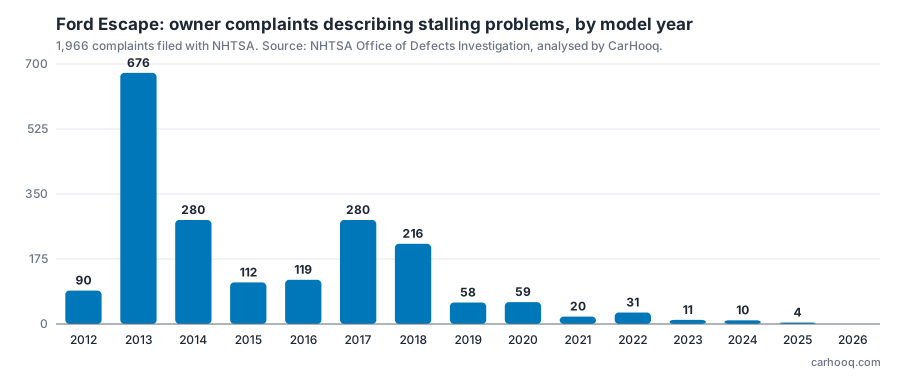
Which Ford Escape years have the most stalling complaints?
| Model year | Reports | All complaints | Share |
|---|---|---|---|
| 2025 | 4 | 32 | 12.5% |
| 2024 | 10 | 91 | 11.0% |
| 2023 | 11 | 140 | 7.9% |
| 2022 | 31 | 390 | 7.9% |
| 2021 | 20 | 387 | 5.2% |
| 2020 | 59 | 1,845 | 3.2% |
| 2019 | 58 | 602 | 9.6% |
| 2018 | 216 | 1,825 | 11.8% |
| 2017 | 280 | 2,705 | 10.4% |
| 2016 | 119 | 1,186 | 10.0% |
| 2015 | 112 | 1,142 | 9.8% |
| 2014 | 280 | 2,090 | 13.4% |
| 2013 | 676 | 2,757 | 24.5% |
| 2012 | 90 | 619 | 14.5% |
The 2013 Escape stands out: nearly one complaint in four for that year is about stalling or power loss. The 2012 and 2014 years also have a higher share than the model average of 12.4%. The 2017 and 2018 years have the next largest counts, with 280 and 216 reports. Newer years have fewer reports in part because they have had less time on the road The 2020 model year has the lowest share (3.2%) of any year with 50 or more reports.
What do Escape owners describe?
Many of the complaints name the engine, and a large group describe coolant getting into a cylinder. A 2018 owner wrote of a "sudden misfire, loss of power, and internal coolant intrusion at Cylinder 2" (NHTSA complaint 11774626). A 2019 owner described "rough cold starts and white exhaust smoke" before a dealer "confirmed internal coolant leaking into the 2nd engine cylinder" (11775300). A 2015 owner reported that the "engine started running ruff, and stalling and white smoke coming from exaust" (11750758, converted from capitals).
Some owners describe stalling in traffic. A 2016 owner wrote that a misfire "on cylinder #4 again while on the freeway doing 55 MPH which caused the car to stall on the freeway in traffic" (11774294). A 2021 owner reported: "Engine will periodically and randomly stall and quit while driving. Mostly in city but it quit while driving on highway I-10 at 65 mph in one incident" (11764188).
Others point to the transmission or electrical system. A 2023 owner wrote that the transmission "faltered, grinded, tried to shift" and that the car "has stalled twice on the road at a stop light/stop sign since August 2026" (11773832). A 2022 owner reported that "whenever the A/C was engaged, the engine stalled and could not restart normally until the A/C was turned off" (11774820).
A 2025 owner described running out of range while the gauge still showed a quarter tank: "over approximately the next minute, the distance to empty rapidly decreased to 0, at which point the vehicle stopped moving while in the right lane of traffic" (11757994).
These are individual owner accounts. They are not diagnoses, and the data does not show that any one cause explains all the reports. Of the 1,966 reports, 1,081 name the engine, 401 the power train, 281 the electrical system, 260 the fuel or propulsion system, 220 engine cooling and 119 steering.
Is there a recall for stalling on the Escape?
NHTSA lists several recalls that involve a loss of drive power or an engine stall on certain Escapes. Check each against your model year and your VIN:
| Campaign | Model years | Defect (per the recall) | Remedy |
|---|---|---|---|
| 21V625000 | 2021 | Fuel delivery module may leak inside the tank, causing low fuel pressure which could result in an engine stall | Replace the fuel delivery module |
| 21V869000 | 2021 (2.5L hybrid) | High voltage battery may fail, resulting in a sudden loss of drive power | Replace the high voltage battery |
| 22V149000 | 2021 to 2022 (2.5L hybrid) | High voltage battery may fail, resulting in a sudden loss of drive power | Replace the high voltage battery |
| 22V331000 | 2020 (2.5L hybrid) | Insufficient welds inside the high voltage battery may fail, resulting in a loss of drive power | Replace the high voltage battery |
| 24V330000 | 2020 to 2022 | Hybrid powertrain control module software may cause the vehicle to shift into neutral unexpectedly, causing a loss of drive power | Dealer updates the software |
| 25V133000 | 2022 | Same software issue, for vehicles previously repaired incorrectly under 24V-330 | Dealer updates the software |
For each of these recalls, NHTSA states that the risk is a crash, and that the repair is free of charge. None of them is marked as a "do not drive" recall. Owners can contact Ford customer service at 1-866-436-7332.
The recalls above do not cover the cylinder coolant complaints that dominate the 2013 to 2019 reports. As of the data date, NHTSA's recall data for these model years has no recall matching that problem, though recalls for other parts may still apply to your car. One 2020 owner (11772385) mentions a recall 25V467 for hesitant acceleration, but the owner says a dealer reported that no remedy was available. It is not in the recall list above, so check its status for your VIN.
What should you do if your Escape stalls?
- Check open recalls for your VIN at NHTSA recalls. Recalls are repaired free of charge.
- Report the problem at NHTSA report a safety problem. Complaints like the ones above are how patterns become visible.
- Write down dates, mileage, warning messages, and the conditions each time it happens (cold start, air conditioning on, highway, fuel level).
- Ask a dealer to check for open recalls and manufacturer service bulletins for your model year and engine.
- If the car loses power in traffic, put the hazard lights on, steer to a safe place if you can, and call for help rather than driving it further.
I am not a mechanic, so I would not guess at a repair. I would check the VIN first, then take the written notes to a dealer.
How this guide was made
This guide uses NHTSA owner complaint and recall data as of 16 November 2026. Complaints were matched to stalling and loss of power from the text owners wrote, so a report can appear here even if the owner used different words. Counts are reports, except where noted as people injured. Read more in the methodology.