Ford Escape transmission failure problems: what 567 owners reported
Owners filed 567 NHTSA complaints about Ford Escape transmission failure, slipping or a replaced transmission. That is 3.6% of the 15,827 complaints on file for the model. The reports cluster in model years 2013 to 2017, with 2014, 2015, 2016 and 2017 each above 80 reports. Most of them describe the car losing drive, not shifting properly or needing a new transmission, often with no warning beforehand.
Several recalls touch the Escape transmission area, but each one covers a specific defect (a shifter cable bushing, a start/stop accumulator, or hybrid control software), not transmission failure in general. If this is not your case, read the full Ford Escape problem report.
TL;DR
- 567 complaints mention transmission failure, slipping or a replaced transmission: 3.6% of 15,827 Escape complaints.
- Worst model years by count: 2014 (118 reports), 2016 (101), 2017 (92) and 2015 (83).
- Highest share of a year's complaints: 2016 at 8.5% and 2015 at 7.3%.
- 487 of the reports name the Power Train component; 90 name the Engine.
- Reports mentioning a crash: 1. Reports mentioning a fire: 3. The reports list 1 injury in total.
- Six recalls touch the transmission area: 25V133000, 24V330000, 22V413000, 22V254000, 20V550000 and 18V471000.
- Check your VIN for open recalls at the NHTSA recalls page before anything else.
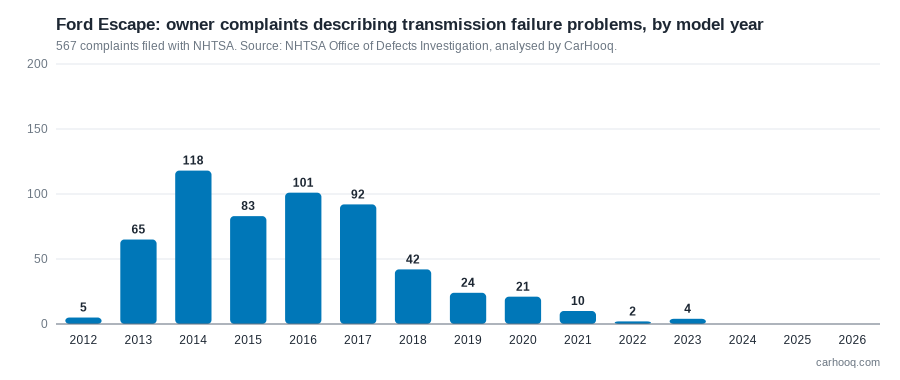
Which Ford Escape years have the most transmission failure complaints?
| Model year | Reports | All complaints | Share |
|---|---|---|---|
| 2023 | 4 | 142 | 2.8% |
| 2022 | 2 | 394 | 0.5% |
| 2021 | 10 | 389 | 2.6% |
| 2020 | 21 | 1,847 | 1.1% |
| 2019 | 24 | 602 | 4.0% |
| 2018 | 42 | 1,825 | 2.3% |
| 2017 | 92 | 2,705 | 3.4% |
| 2016 | 101 | 1,186 | 8.5% |
| 2015 | 83 | 1,142 | 7.3% |
| 2014 | 118 | 2,090 | 5.6% |
| 2013 | 65 | 2,757 | 2.4% |
| 2012 | 5 | 619 | 0.8% |
Model years 2024 to 2026 have no matching reports so far.
The 2014 year has the most reports, but 2016 and 2015 have the highest share of their own complaints, at 8.5% and 7.3%. For those two years, transmission trouble makes up a bigger slice of what owners write about than for any other year. Newer cars (2021 to 2023) have few reports, which may simply reflect less time on the road.
What do Escape owners describe?
Loss of drive with no warning. This is the most repeated point. A 2016 owner wrote: "Complete transmission failure while driving. Gears blew completely apart" (NHTSA complaint 11771942). A 2017 owner described "driving on busy road when transmission failed and car wouldn't move" and "No warning of any kind prior to failure" (11756473).
Trouble pulling away or climbing. A 2018 owner reported that at a stoplight "it had trouble shifting out of the first gear" and later "it would not go uphill and began slowly rolling backwards" (11773887). A 2019 owner wrote "Car would only move at high rpms" (11771486).
Hunting for gears and lag. A 2022 owner said "It seems to search a lot for the right gear" and that "half the time you hit the gas there is severe transmission lag" (11762517).
Repeat failures after replacement. A 2015 owner wrote that the replacement transmission "needed to be replaced again" with less than 6000 miles on it (11772728). The 2022 owner above reported a first replacement at "roughly 36000 miles" and symptoms again at 47000 miles.
What shops and dealers found. A 2013 owner said two repair shops "found metal shavings in the fluid" and quoted a $6,000 replacement (11684132). A 2020 owner's shop notes record "harsh engagment" in the 2-3 and 4-5 gears and fluid "dark with metal debri" (11777541). A 2014 owner wrote that the mechanic "said the shifter cable bushing was faulty, which was exactly the part covered by the recall they had previously done" (11760815).
These are owners' own accounts, not confirmed diagnoses. Across all 567 reports, the components named are Power Train (487), Engine (90), Electrical System (21), Vehicle Speed Control (17), Fuel/Propulsion System (13) and Service Brakes (7). One report mentions a crash and three mention a fire.
Is there a recall for transmission problems on the Escape?
There are recalls in the transmission area, but each has a specific defect. None is a general transmission failure recall.
| Campaign | Model years | Defect | Fix |
|---|---|---|---|
| 25V133000 | 2022 | Hybrid powertrain control module software may cause the vehicle to shift into neutral unexpectedly; earlier repaired incorrectly under 24V-330 | Software update, free of charge |
| 24V330000 | 2020 to 2022 | Same hybrid software issue, a loss of drive power | Software update, free of charge |
| 22V413000 | 2013 to 2019 | Shifter cable bushing may degrade or detach | Replace the shift bushing and add a protective cap, free of charge |
| 22V254000 | 2015 (2.0L) | Shifter cable bushing may degrade or detach | Same remedy |
| 20V550000 | 2020 | Start/stop accumulator endcap may have missing or loose bolts, possible transmission fluid leak and loss of transmission function | Replace the accumulator, free of charge |
| 18V471000 | 2013 to 2014 (six-speed) | Shifter cable bushing may detach, so the car may not be in Park with no warning | Replace the bushing, free of charge |
For the bushing recalls, the recall text says a damaged bushing may prevent the vehicle from shifting into the intended gear and the vehicle may roll after Park is selected. The 25V133000 and 24V330000 recalls say the consequence of a loss of drive power is an increased risk of a crash. None of these is flagged "do not drive" in the data.
A recall covering one part does not mean it covers every transmission fault. Some owners above mention a "known problem" with specific transmissions, but that is their own statement; this guide found no recall for those claims.
What should you do if your Escape loses drive or slips?
These steps use only official sources and the recall text above.
- Check open recalls by VIN at nhtsa.gov/recalls. I would do this before paying for any transmission diagnosis, because several recalls are free repairs.
- Write down dates, mileage, warning messages and the conditions: cold start, stop and go, uphill, reversing.
- Ask a dealer to check for open recalls and manufacturer service bulletins for your VIN and model year.
- If the car will not move, rolls back on a hill or loses power in traffic, stop driving and call for help. Do not keep driving it to see if it recovers.
- Report the problem at nhtsa.gov/report-a-safety-problem. Reports are how patterns like this show up in the data.
How this guide was made
The data comes from NHTSA owner complaints and recall records, as of 2026-11-23. A complaint counts here when its text describes transmission failure, slipping or a replaced transmission. The model year table counts complaints per year. See the methodology for how matching works and its limits. Quotes are shortened but not reworded, and all-caps text is converted to sentence case.