Ford Explorer stalling problems: what 805 owners reported
Owners filed 805 NHTSA complaints about the Ford Explorer stalling, losing power or shutting off while driving. That is 5.7% of the 14,136 complaints on file for the Explorer (model years 2012 to 2026). The 2013 model year has the most with 172 reports, followed by 2016 with 157. This group is broad: the reports describe engines that cut out, cars that lose drive power, and also power steering assist that disappears while the engine keeps running.
NHTSA's recall data lists five Ford recalls that mention a loss of drive power or an engine stall on Explorer model years 2021 to 2025, covering the fuel pump, engine software, the EGR valve and engine internals. None is a blanket answer for every year. If this is not your case, read the full Ford Explorer problem report.
TL;DR
- 805 complaints mention stalling, loss of power or the engine shutting off, 5.7% of 14,136 Explorer complaints.
- 2013 is the worst year with 172 reports (7.7% of that year's 2,239 complaints). 2016 has 157 and 2020 has 82.
- The reports name steering 297 times, engine 228 times, power train 199 times, electrical system 90 times, fuel system 61 times and vehicle speed control 52 times.
- 8 reports mention a crash and 4 mention a fire. The reports list 8 injuries in total.
- Recall 25V455000 (2021 to 2023 Explorer and other Ford models) covers a low-pressure fuel pump that may fail and cause an engine stall while driving.
- Recall 25V239000 (2025 Explorer) covers a powertrain control module that may reset while driving, which can cause an engine stall.
- Recall 24V635000 (2021 to 2022, 2.7L or 3.0L Nano EcoBoost) covers intake valves that may break and cause a loss of drive power.
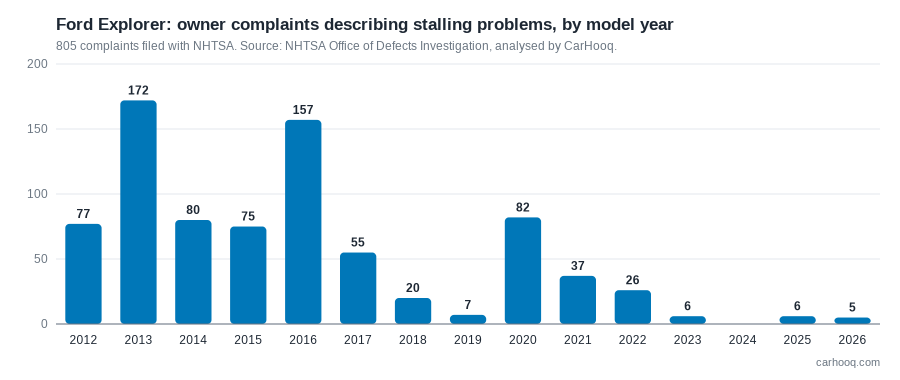
Which Ford Explorer years have the most stalling complaints?
| Model year | Reports | All complaints | Share |
|---|---|---|---|
| 2026 | 5 | 46 | 10.9% |
| 2025 | 6 | 114 | 5.3% |
| 2024 | 0 | 31 | 0.0% |
| 2023 | 6 | 115 | 5.2% |
| 2022 | 26 | 280 | 9.3% |
| 2021 | 37 | 469 | 7.9% |
| 2020 | 82 | 1,265 | 6.5% |
| 2019 | 7 | 303 | 2.3% |
| 2018 | 20 | 737 | 2.7% |
| 2017 | 55 | 1,715 | 3.2% |
| 2016 | 157 | 2,485 | 6.3% |
| 2015 | 75 | 1,823 | 4.1% |
| 2014 | 80 | 1,684 | 4.8% |
| 2013 | 172 | 2,239 | 7.7% |
| 2012 | 77 | 830 | 9.3% |
Two clusters stand out in raw numbers: 2013 and 2016 together account for 329 of the 805 reports. By share, the 2012 and 2022 model years sit highest among the years with a large sample, at 9.3% each. The 2026 share of 10.9% comes from only 5 reports out of 46, so it says little yet. The newest years have had less time on the road, which keeps their counts low, and 2024 has no matching reports at all.
What do Explorer owners describe?
The wording in these complaints splits into a few different stories, so it helps to read them separately.
The engine stalls or loses power. One 2019 owner (complaint 11672764) described heat as a factor: "On 3 separate occasions my car has stalled when driving. All three were after driving for several hours in hot weather." The same owner wrote that "all three times after waiting for about 45 minutes the car will start again. Sluggish at first and then drives normal." A 2026 owner (11748926) wrote: "This 2026 Ford Explorer has stopped, stalled, hesitated and jerks after fuel fill-ups. It stopped twice for myself in busy intersections." That owner added that the dealer "told me I could not have my car back for safety reasons."
A warning light and a sudden loss of power. A 2018 owner (11745317) wrote that "the wrench warning light suddenly illuminated on the dashboard. At the same time, the vehicle experienced a significant loss of power and became extremely sluggish in acceleration."
Repeated drivability faults. A 2023 ST owner (11746273) reported "delayed acceleration, hesitation, erratic RPM behavior, harsh shifting, loss of power, and intermittent warning lights" and wrote that "the vehicle has also stalled." A 2022 owner (11777521) listed "hard shifting and stalling" and "metal in transmission oil."
Engine failure at speed. A 2021 ST owner with the 3.0L EcoBoost (11777616) wrote that the engine "suffered a catastrophic internal engine failure and completely seized while driving at approximately 70 mph." The owner said the car falls under Ford's safety recall 24S55 and that the dealership was refusing to honor it. I cannot verify the dealer's side from the complaint alone.
Power steering loss. The largest component group in this data is steering, and many of these reports describe the engine running while the steering assist drops out. A 2013 owner (11738002) wrote of a "power steering assist fault while driving with total loss of power steering" and a recall on earlier builds that the dealer said did not cover that car. A 2014 owner (11749538) reported a melted "150A EPAS Mega Fuse" and a fire risk, with photos attached. Because this is a different fault from an engine stall, check which one you have before comparing your car with these numbers.
Not every complaint in the group is about a stall. The matching looks for owner wording about power loss and shut-offs, so some reports touch other parts, including a 2020 owner (11768857) whose low beams shut off in motion at night. Of the 805 reports, 8 mention a crash and 4 mention a fire, and the reports list 8 injuries in total.
Is there a recall for stalling on the Explorer?
NHTSA's recall data lists these campaigns for Explorer model years that mention a stall or a loss of drive power:
| Campaign | Model years | Defect named | Fix |
|---|---|---|---|
| 25V455000 | 2021 to 2023 | Low-pressure fuel pump may fail and cause an engine stall while driving | Dealers update the PCM software on all affected vehicles except Super Duty trucks, which get a new pump. Free of charge. Ford number 25S75. |
| 25V239000 | 2025 | PCM may reset while driving, which can damage the park system or cause an engine stall | Dealers update the PCM software, free of charge. Ford number 25S35. |
| 24V635000 | 2021 to 2022 | Intake valves may break on 2.7L or 3.0L Nano EcoBoost engines, causing engine failure and a loss of drive power | Dealers perform an engine cycle test and replace the engine as necessary, free of charge. Ford number 24S55. |
| 26V122000 | 2025 | EGR valve may fail, causing an unexpected loss of drive power | Dealers replace the EGR valves, free of charge. Ford number 26S10. |
| 26V343000 | 2025 to 2026 (the Explorer is listed with Ranger and Bronco) | Engine may fail, which can result in a loss of drive power | Dealers replace the engine long block, free of charge. Ford number 26S35. |
For each of these, NHTSA says the consequence is a higher risk of a crash. None of the five carries a "do not drive" or "park outside" instruction in the data. These recalls apply only to the listed model years and to vehicles Ford identified, often by engine or build date. An Explorer from 2012 to 2020 does not appear in any of them, and the older steering recall mentioned in owner complaints is a separate matter. Check your own VIN before assuming you are in or out.
What should you do if your Explorer stalls?
These steps come from NHTSA and from what the recalls above say:
- Check your VIN for open recalls at NHTSA's recall page. Recalls are free to repair, and the lookup shows only the ones that apply to your exact car.
- Write down what happens. Date, mileage, warning messages, whether the engine was hot or cold, how much fuel was in the tank and whether the car restarted. The 2019 owner above recorded the 45-minute wait, which is the kind of detail a dealer can use.
- Ask your dealer to check for open recalls and manufacturer service bulletins that match your VIN and symptoms, and ask for the result in writing.
- Report it at NHTSA's report a safety problem page. These reports are where the numbers in this guide come from.
- If the car loses power in traffic, stop driving it. Move to a safe place when you can, switch on the hazard lights and call for help rather than trying again on the highway.
I am not a mechanic, so I would not guess at a cause from the symptom alone. Several different faults show up under "stalling", and the right fix depends on which one your car has.
How this guide was made
The data comes from complaints owners filed with NHTSA, matched to this symptom by the wording of the owner's description, plus NHTSA's recall records for the Explorer. It reflects the brief dated 2026-11-23. Complaints are unverified owner accounts and do not prove a defect. For the full method, read the carhooq methodology page, and for other model years see the 2020 report and the 2016 report.