Ford F-150 brake problems: what 642 owners reported
Owners have filed 642 complaints with NHTSA about Ford F-150 brakes feeling soft, failing, grinding or squealing. That is 3.8% of the 17,089 complaints on file for the model. The reports cover model years 2012 to 2026, but they cluster in 2013 to 2016, and the most serious ones describe a brake pedal that goes to the floor.
Ford has issued four brake recalls that cover F-150 trucks, all tied to a master cylinder that can leak brake fluid into the brake booster. Several owners say their truck was not included in a recall even though it failed the same way. If this is not your case, read the full Ford F-150 problem report.
TL;DR
- 642 complaints about brakes, 3.8% of all 17,089 F-150 complaints in NHTSA's data.
- 45 reports mention a crash and 0 mention a fire. The reports list 18 injuries in total.
- 2013 to 2016 model years account for 520 of the 642 reports (81%). 2015 has the highest share at 9.5% of that year's complaints.
- Recall 20V332 (2014 to 2017 trucks with the 3.5L Ecoboost engine) and recall 22V150 (2016 to 2018) cover a master cylinder that may leak brake fluid into the brake booster.
- Recall 25V236 (2017 to 2018 F-150) covers the same kind of leak. Ford's number for it is 25S37.
- Recall 19V805 (2019 to 2020) covers a battery cable fastener that may loosen and affect braking assist.
- Check your VIN at the NHTSA recall page before you assume your truck is or is not covered.
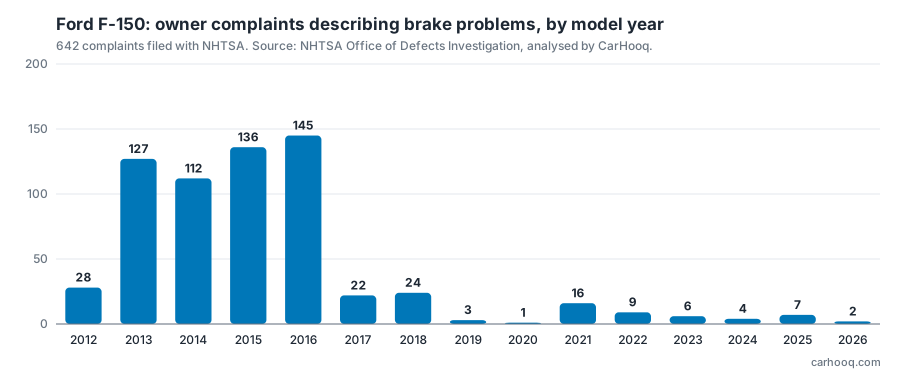
Which Ford F-150 years have the most brake complaints?
| Model year | Reports | All complaints | Share |
|---|---|---|---|
| 2026 | 2 | 21 | 9.5% |
| 2025 | 7 | 140 | 5.0% |
| 2024 | 4 | 269 | 1.5% |
| 2023 | 6 | 632 | 0.9% |
| 2022 | 9 | 920 | 1.0% |
| 2021 | 16 | 1,331 | 1.2% |
| 2020 | 1 | 567 | 0.2% |
| 2019 | 3 | 1,025 | 0.3% |
| 2018 | 24 | 1,934 | 1.2% |
| 2017 | 22 | 1,150 | 1.9% |
| 2016 | 145 | 1,800 | 8.1% |
| 2015 | 136 | 1,425 | 9.5% |
| 2014 | 112 | 1,362 | 8.2% |
| 2013 | 127 | 2,796 | 4.5% |
| 2012 | 28 | 1,717 | 1.6% |
The 2013 to 2016 trucks stand out: four consecutive years with 112 to 145 reports each, and brakes make up 8% to 9.5% of complaints for 2014, 2015 and 2016. From 2017 the counts drop sharply. The 2025 and 2026 percentages look high only because those years have few complaints overall (140 and 21), so a handful of brake reports moves the share a lot. Newer trucks have also had less time on the road to collect reports.
What do F-150 owners describe?
Almost all of the reports name the service brakes (620 of 642). The hydraulic system is named in 45, the power train in 15, the electrical system in 14, the engine in 12 and vehicle speed control in 12. Reports can name more than one component.
The pedal goes to the floor. This is the most common description, and it often comes with no warning. A 2016 owner wrote: "I went to start my truck and the brake went all the way to the floor. I had no braking power and it had to be towed back home over an hour away." (NHTSA complaint 11754135). A 2014 owner wrote: "While driving the brakes failed and pedal was to the floor. No warning light before this happened. Warning light eventually came on after the failure." (11670286).
Master cylinder and booster findings. Some owners report what a shop told them. A 2012 owner wrote: "While traveling at high way speed my brakes failed." and later "it was diagnosed as master cylinder & brake booster failure." (11611274). A 2014 owner reports a shop "confirmed it is a failure of the master cylinder and brake booster." (11670286). These are owners passing on a shop's diagnosis, not findings I can confirm.
Leaking lines and hoses. Not every report points at the master cylinder. A 2015 owner wrote: "Front passenger side brake line (plastic) burst - causing no braking on vehicle." (11616346). A 2017 owner wrote: "It's leaking brake fluid all over from the front passenger brake hose. The dealership says it is not under recall or fixable by warranty." (11611703).
Warning messages. Newer trucks describe a stack of alerts. A 2022 owner listed: "Three warnings light up: Antilock Brake Fault, Hill Start Assist Warning, and Pre-Collision Assist Not Available." (11620661). A 2025 owner listed: "Parking brake service limited, Brake system failure alert, service advancedtrac." before the pedal went to the floor (11767506).
Repeat failures and cost. A 2026 owner wrote: "This is the third complete brake failure in less than 300 miles on the vehicle." (11760203). A 2024 owner wrote: "I took the truck to the dealership and quoted me around $2,500." (11740632). That figure is one owner's quote, not a typical price.
Not covered by a recall. A 2013 owner with 105,871 miles wrote that "because our VIN has not been listed in any recall, we are out of luck on any help with repairs." (11665183). A 2016 owner wrote: "I went to Ford and they told me the recall did not apply to this specific truck due to a different batch of parts." (11754135).
Is there a recall for brake problems on the F-150?
Yes, several, though each covers specific trucks. According to NHTSA's recall data:
| Campaign | Model years | What the recall says |
|---|---|---|
| 20V332 (June 2020) | 2014 to 2017 F-150 with 3.5L Ecoboost | The brake master cylinder may leak brake fluid into the brake booster. Dealers replace the master cylinder and inspect the booster, replacing it as necessary, free of charge. Ford's number: 20S31. |
| 22V150 (March 2022) | 2016 to 2018 F-150 with 3.5L Ecoboost (also 2016 to 2017 Expedition and Navigator) | Expands 20V332. Dealers replace the master cylinder, and the booster if the master cylinder is leaking, free of charge. |
| 25V236 (April 2025) | 2017 to 2018 F-150 (also Expedition and Navigator) | Expands 22V150. Same fix, free of charge. Ford's number: 25S37. |
| 19V805 (November 2019) | 2019 to 2020 F-150 | A fastener on the positive battery terminal may loosen and affect systems such as instrument panel displays and braking or steering assist. The engine could also stall. Dealers inspect and retorque the joint as necessary. Ford's number: 19S40. |
NHTSA describes the risk in the master cylinder recalls as a loss of brake fluid that changes pedal travel and feel, raises pedal effort and reduces front brake function, increasing the risk of a crash. The recall text for 19V805 also says the condition could create a resistive short, increasing the risk of a fire.
Two more recalls touch the instrument cluster on 2017 trucks (17V053 and 26V370). They concern gauges and the gear position indicator, not brake hardware.
Notice what the list does not cover. Owners of 2012, 2013, 2019 (for the master cylinder), 2021 and later trucks describe similar failures, and the recall text does not include those trucks. I cannot tell you whether a failure on your truck is related to any recall; only a dealer can check your VIN against open campaigns.
What should you do if your F-150 brakes feel soft or fail?
- If the pedal sinks or the car loses braking in traffic, stop driving and call for help. Do not keep topping up fluid and driving, as one owner describes having to do.
- Check your VIN for open recalls at the NHTSA recall page.
- Write down the date, mileage, warning messages, weather and speed when it happened, and whether the brake fluid level dropped.
- Ask a Ford dealer to check for open recalls and any manufacturer service bulletins that apply to your VIN. Keep the repair invoice.
- Report the problem at NHTSA's safety problem page.
I would not drive a truck with a pedal that sinks or a brake fluid level that keeps falling, and I would not rely on a "not under recall" answer alone.
How this guide was made
The numbers come from NHTSA consumer complaints and recall records for the Ford F-150, model years 2012 to 2026, as of 16 November 2026. Complaints were counted when the owner's own text described brakes feeling soft, failing, grinding or squealing. Quotes are copied from the complaints with the complaint number, and spelling is left as filed. Read how the matching works on the methodology page. Complaints are unverified owner statements, so they show patterns, not causes.