Ford F-150 check engine light problems: what 938 owners reported
Owners have filed 938 complaints with NHTSA that mention the check engine light on the Ford F-150. That is 5.5% of the 17,050 complaints on file for the model. The reports come from model years 2012 to 2025, and the two oldest years in the data, 2012 and 2013, account for 392 of them.
The light is a warning, not a diagnosis, and the reports behind it describe very different things: transmission downshifts, loss of power, a hybrid battery code, sensor faults. NHTSA's recall data for these model years has no recall matching this problem as of 9 November 2026, although owners mention recalls for other parts. If this is not your case, read the full Ford F-150 problem report.
TL;DR
- 938 of 17,050 F-150 complaints (5.5%) mention the check engine light.
- The worst years by count are 2013 (241 reports) and 2012 (151 reports).
- By share of each year's complaints, 2012 (8.8%) and 2013 (8.6%) are highest.
- 5 reports mention a crash and 1 mentions a fire. The reports list 6 injuries in total.
- The components named most often are Engine (510 reports) and Power Train (394 reports).
- No recall in NHTSA's data matches this symptom as of the brief date; check your own VIN anyway.
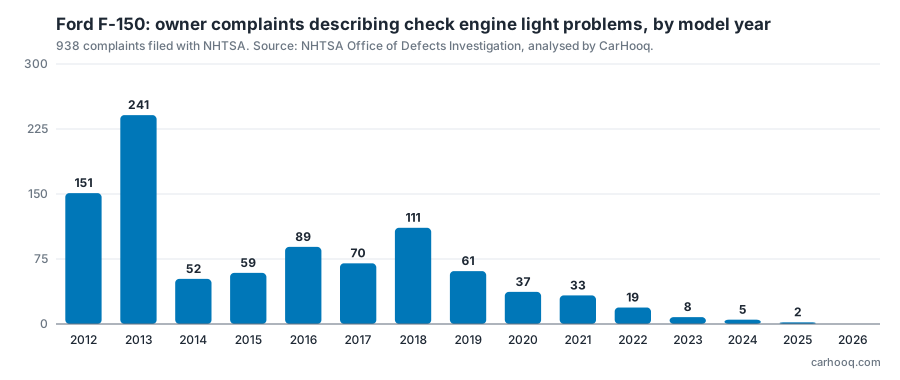
Which Ford F-150 years have the most check engine light complaints?
| Model year | Reports | All complaints | Share |
|---|---|---|---|
| 2025 | 2 | 140 | 1.4% |
| 2024 | 5 | 265 | 1.9% |
| 2023 | 8 | 626 | 1.3% |
| 2022 | 19 | 914 | 2.1% |
| 2021 | 33 | 1,310 | 2.5% |
| 2020 | 37 | 566 | 6.5% |
| 2019 | 61 | 1,025 | 6.0% |
| 2018 | 111 | 1,934 | 5.7% |
| 2017 | 70 | 1,150 | 6.1% |
| 2016 | 89 | 1,800 | 4.9% |
| 2015 | 59 | 1,425 | 4.1% |
| 2014 | 52 | 1,362 | 3.8% |
| 2013 | 241 | 2,796 | 8.6% |
| 2012 | 151 | 1,717 | 8.8% |
The reports cluster in 2012 and 2013, which together hold 392 of the 938 and also have the highest share of their own year's complaints. 2018 is the next largest by count with 111. From 2021 onward the numbers fall, and the 2026 model year has none so far (out of 20 complaints). Newer trucks have had less time on the road, so lower counts there do not show that those trucks are free of the problem.
What do F-150 owners describe?
The check engine light is rarely the whole story. The most common pattern in the quotes is a light that appears together with a transmission event. One 2013 owner (NHTSA complaint 11656469) reports a code and a sudden downshift at highway speed: "I was driving 70mph all of sudden the truck made a loud bang and I was in 6th gear and the truck went from being in 6th gear just dropped into 1st gear". The same owner adds: "Immediately I seen a big yellow wrench on the dashboard along with the check engine light". A 2015 owner (11671943) describes something similar: "Going about 70 mph and the truck dropped down into second or first gear almost causing an accident. Had to pull over on the side of the road. Check engine light was on the dash."
Other owners describe loss of power. A 2019 owner (11772484) writes: "Check engine light on, engine is sluggish when accelerating especially from a stop." The same report says the engine "has actually stopped at intersections, while going through car wash, at a stop."
Some reports point to emissions and software. A 2018 owner (11772031) says a mandatory recall, 24E12, "reprogrammed the Powertrain Control Module (PCM) to stricter emissions monitoring standards" and that the light then appeared "within 24hrs showing code P0430." The owner reports that Ford is denying responsibility and charging $2,500+ out of pocket to replace the converter. That is the owner's account, not a finding by NHTSA or Ford.
Newer trucks show different details. A 2021 PowerBoost owner (11770359) says the light "came on for P0B24 for hybrid battery failure" about two hours after a dealer visit, and that the dealer confirmed the battery has to be replaced. A 2022 owner (11755591) describes the engine stopping on an interstate in 112 degrees F heat: "Engine stopped, check engine light came on and a 'stop safely' indicator appeared." A 2024 owner (11766816) documents a recurring knock sensor fault with the light coming back after a replacement.
Across the whole set, the components named most often are Engine (510 reports), Power Train (394), Vehicle Speed Control (105), Engine And Engine Cooling (84), Electrical System (71) and Fuel/Propulsion System (63). Five reports mention a crash, one mentions a fire, and the reports list six injuries in total.
Is there a recall for the check engine light on the F-150?
NHTSA's recall data for these model years has no recall matching this problem as of the brief date. That does not mean no recall applies to your truck: recalls for other parts, such as the transmission software campaigns some owners mention, may still be open. Owners quote campaign numbers such as 19S07 and 24E12 in their own complaints, but I have not checked those against NHTSA's recall data here, so enter your VIN on NHTSA's recall page and read what it lists. The Ford F-150 problem report shows the recalls on file for each model year.
What should you do if your F-150 check engine light comes on?
These are the safe, sourced steps:
- Check open recalls for your VIN at nhtsa.gov/recalls.
- Write down the date, mileage, any warning messages on the dash and the conditions when it happened, such as speed, temperature or just after a dealer visit.
- If the light comes with a power loss, a sudden downshift or a stop-safely message, stop driving when it is safe to do so and call for help rather than carrying on. Several owners above describe losing power in traffic.
- Ask a dealer to read the stored code, check for open recalls and look up manufacturer service bulletins for your model year. A code names a circuit or a system, and the dealer decides the cause.
- Report the problem at nhtsa.gov/report-a-safety-problem. Reports are how the complaints counted above reach NHTSA.
I am not a mechanic, so I would start with the VIN check and the notes before spending money on parts.
How this guide was made
The data comes from NHTSA's public owner complaints for the Ford F-150, retrieved on 9 November 2026. A complaint counts as a check engine light report when the owner's text mentions the light. Quotes are copied from the complaints with their NHTSA numbers, and shares are the symptom reports divided by all complaints for the same model year. More detail is on the methodology page. You can also browse the 2013 report and the 2012 report.