Ford F-150 rough idle and misfire problems: what 602 owners reported
Owners filed 602 NHTSA complaints about rough idling, misfires or hesitation when accelerating on the Ford F-150. That is 3.5% of the 17,089 complaints on file for the model. Reports exist for every model year from 2012 to 2024, plus one for 2026, and the most come from 2012, 2018 and 2019 trucks.
NHTSA's recall data for these model years has no recall matching this problem as of November 2026. Six of the 602 reports mention a crash, none mention a fire, and the reports list 1 injury in total. If this is not your case, read the full Ford F-150 problem report.
TL;DR
- 602 complaints describe rough idle, misfire or hesitation, 3.5% of 17,089 F-150 complaints.
- The worst years by count are 2012 (115 reports), 2018 (106) and 2013 (86).
- The highest share of a year's complaints is 2019 (6.8%), 2012 (6.7%) and 2018 (5.5%).
- 6 reports mention a crash, 0 mention a fire, and the reports list 1 injury in total.
- The reports most often name Power Train (308) and Engine (292) as the component.
- No recall in NHTSA's data matches this symptom for these model years.
- Check your own VIN for open recalls at the NHTSA recalls page before anything else.
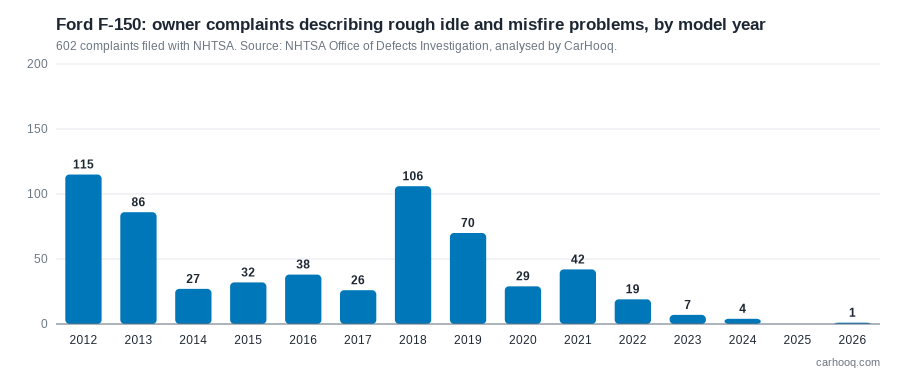
Which Ford F-150 years have the most rough idle complaints?
| Model year | Reports | All complaints | Share |
|---|---|---|---|
| 2026 | 1 | 21 | 4.8% |
| 2025 | 0 | 140 | 0.0% |
| 2024 | 4 | 269 | 1.5% |
| 2023 | 7 | 632 | 1.1% |
| 2022 | 19 | 920 | 2.1% |
| 2021 | 42 | 1,331 | 3.2% |
| 2020 | 29 | 567 | 5.1% |
| 2019 | 70 | 1,025 | 6.8% |
| 2018 | 106 | 1,934 | 5.5% |
| 2017 | 26 | 1,150 | 2.3% |
| 2016 | 38 | 1,800 | 2.1% |
| 2015 | 32 | 1,425 | 2.2% |
| 2014 | 27 | 1,362 | 2.0% |
| 2013 | 86 | 2,796 | 3.1% |
| 2012 | 115 | 1,717 | 6.7% |
There are two clusters. The 2012 and 2013 trucks account for 201 of the 602 reports, and the 2018 and 2019 trucks account for 176. The years in between (2014 to 2017) sit at about 2% of each year's complaints. The 2026 share of 4.8% rests on a single report, so it says little. Newer trucks (2023 and later) have had less time on the road to collect complaints, so their low counts do not prove they are free of the problem.
What do F-150 owners describe?
The wording varies a lot, and some of it describes other faults that the matching picked up, such as harsh transmission shifts. I have kept to what owners wrote about misfires, hesitation and loss of power.
Misfire codes and engine damage. One 2012 owner who describes using a lab scope on the truck wrote: "Cylinder 2 had a stored code for misfire and oil and coolant mixture leaking from block" (complaint 11550095). The same owner reports finding a crack in the block at the cylinder 2 location. That is one owner's own inspection, not a finding that applies to other trucks.
Cam phasers on the 3.5L EcoBoost. Two owners link their symptoms to the variable cam timing system. A 2018 owner wrote that "Drivability is not the same has hesitation" and that a p0018 code and a check engine light came on (complaint 11769152). A 2019 owner with about 80,000 miles describes "severe hesitation during acceleration" and a "violent rattling noise upon cold starts", and refers to Customer Satisfaction Program 21N03 (complaint 11774178). These are the owners' own statements about the cause and the program, and I have not verified them.
Loss of power at idle. A 2015 owner wrote that the engine "loses power to a rough idle and is remedied by putting the vehicle in park and restarting the engine" (complaint 11672034).
Misfire, shaking and stalling on the road. A 2021 owner wrote that "the truck started misfiring and jerking, shaking then stalled", with the engine light flashing, and that it happened a second time about 3 miles later (complaint 11769118). A 2014 owner describes losing all power while passing at highway speed: "Truck lost all power, began to shake violently like it was misfiring, got an illuminated wrench on my dashboard" (complaint 11616772).
Hesitation on a recent truck. A 2022 owner wrote that "This hesitation / stalling has occurred many times", that the dealer diagnosed "a fuel pump issue" and that Ford advised them "to keep the fuel level above a half tank" (complaint 11774474). The owner says the issue was determined to be a recall, but I could not match a recall to it in the data, so check your own VIN.
Across all 602 reports, the components named are Power Train (308), Engine (292), Vehicle Speed Control (67), Fuel/Propulsion System (66), Electrical System (34) and Fuel System (28). A report can name more than one component.
Is there a recall for rough idle on the F-150?
NHTSA's recall data for these model years has no recall matching rough idle, misfire or hesitation as of 16 November 2026. That does not mean your truck has no open recalls. Recalls for other parts may still apply, and the Ford F-150 problem report lists what is on file for the model. The most reliable check is your own VIN on the NHTSA recalls page.
What should you do if your F-150 idles rough or misfires?
- Check your VIN for open recalls at nhtsa.gov/recalls. It takes a minute and is free.
- If the engine light is flashing, I would treat it as serious and avoid hard driving. A 2021 owner above reported a flashing light followed by a stall.
- Write down the date, mileage, any warning messages or codes, and the conditions: cold start, idle, towing, highway speed, low fuel.
- Ask a dealer to check for open recalls, customer satisfaction programs and manufacturer service bulletins for your VIN, and ask for the findings in writing.
- If the truck loses power in traffic, get to a safe place, stop driving and call for help.
- Report the problem at nhtsa.gov/report-a-safety-problem. Reports like the 602 above are how patterns become visible.
For year-specific detail, see the report pages for 2012, 2018 or 2019.
How this guide was made
The data comes from NHTSA owner complaints for the Ford F-150, with a brief dated 16 November 2026. Complaints were counted when the owner's text matched rough idling, misfires or hesitation when accelerating, so some reports describe a related fault rather than exactly this one. Quotes are the owners' words, with capital letters normalised, and each carries its NHTSA complaint number. See the methodology for how the counts work. I am not a mechanic, and none of this is a diagnosis.