Ford Focus check engine light problems: what 1,366 owners reported
Owners of the 2012 to 2018 Ford Focus filed 1,366 NHTSA complaints that mention the check engine light. That is 10.8% of the 12,621 complaints on file for those model years. The light is rarely the only thing owners describe: most of the reports also talk about the transmission, hesitation, stalling or the fuel system, and the light is how the problem first showed up.
The reports span every model year from 2012 to 2018, with 2012 and 2014 having the most in absolute numbers and 2018 the highest share of its complaints. NHTSA's recall data for these years has no recall matching a check engine light as a symptom on its own, although some owners cite recall campaign 18V-735 in their reports (more on that below). If this is not your case, read the full Ford Focus problem report.
TL;DR
- 1,366 reports mention the check engine light, 10.8% of 12,621 Ford Focus complaints (model years 2012 to 2018).
- Most reports: 2012 (261), 2014 (240) and 2018 (206).
- Highest share of a year's complaints: 2018, with 206 of 838 (24.6%).
- Components named most often: Power Train (678 reports), Engine (446), Fuel/Propulsion System (257).
- 5 reports mention a crash and 1 mentions a fire. The reports list 9 injuries in total.
- The related recall list for this symptom is empty. One owner cites NHTSA campaign 18V-735 (canister purge valve) in complaint 11770880.
- A lit check engine light can have many causes. A code reader or a dealer has to read the stored code.
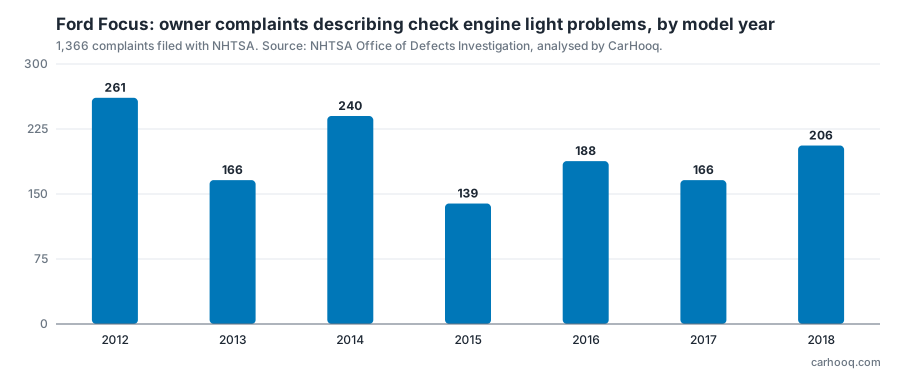
Which Ford Focus years have the most check engine light complaints?
| Model year | Reports | All complaints | Share |
|---|---|---|---|
| 2018 | 206 | 838 | 24.6% |
| 2017 | 166 | 906 | 18.3% |
| 2016 | 188 | 1,196 | 15.7% |
| 2015 | 139 | 1,034 | 13.4% |
| 2014 | 240 | 2,661 | 9.0% |
| 2013 | 166 | 2,181 | 7.6% |
| 2012 | 261 | 3,805 | 6.9% |
The raw counts are highest for 2012 and 2014, but those years also have the most complaints of every kind, so the check engine light is a smaller part of each year's file. In the newer years the picture reverses: 2018 has the fewest total complaints (838) yet the largest share that mention the light (24.6%). The share column rises with each newer year, from 6.9% for 2012 to 24.6% for 2018, because the older years carry many more complaints about other problems. These counts only reflect owners who chose to file with NHTSA, so they say what owners reported, not how many cars are affected.
What do Focus owners describe?
The complaint text mentions the light in several different situations. Grouping what owners wrote, there are a few recurring themes.
The light comes with transmission or shifting trouble. The Power Train component is named in 678 reports, the largest group. A 2018 owner described the light in the middle of other symptoms: "Jerking and barely accelerating, then it decides to driver in between gaps." and ended with "Just the check engine light came on." (complaint 11763507). A 2013 owner wrote: "my check engine light came on and it threw a code P07A5." after hesitation and jerking while accelerating (complaint 11738402).
Owners report specific stored codes. A 2018 owner wrote: "Today my check engine light came on, and I had a code pulled and it was clutch A like I told them (P0902)." (complaint 11754311). Another owner describes a different code: "The vehicle presented with an active check engine light for diagnostic trouble code P0420 (Catalyst System Efficiency Below Threshold)." (complaint 11770880). These are the owners' own accounts of what their codes were, and the codes differ from car to car.
The light is linked to the canister purge valve in some reports. A 2016 owner wrote: "the code was p1450 the mechanic told me it’s the purge valve" and said the dealer "have to do their diagnostic that will cost 190$" (complaint 11741600). This is one owner's account of what a mechanic and a dealer told them.
Warning light plus stalling or fuel symptoms. A 2012 owner wrote: "Check engine light is on with fuel/emissions-related codes." alongside stalling at low speeds (complaint 11744465). The Fuel/Propulsion System (257 reports), Fuel System (203) and Gasoline (200) components appear often next to the light.
The light plus a stop in traffic. A 2015 owner wrote: "The Check Engine light was popping from the TCM indicator which I was told I could still drive on without repairing it immediately." and said the car stopped in traffic twice in a week (complaint 11745120). I would not take that as advice for your own car: if a car stops or loses power in traffic, that needs prompt attention.
Across all 1,366 reports, the Engine component is named 446 times and the Electrical System 78 times. Five reports mention a crash, one mentions a fire, and the reports list 9 injuries in total.
Is there a recall for the check engine light on the Focus?
The recall list matched to this symptom is empty. As of the data date (2026-11-16), NHTSA's recall data for the 2012 to 2018 Focus has no recall matching "check engine light" as a problem on its own. That does not mean no recall applies to your car: recalls for other parts, such as the transmission or fuel system, may be open on your VIN.
Some owners refer to a recall in their own words. In complaint 11770880 (a 2016 Focus) the owner says the vehicle is "subject to NHTSA Safety Recall Campaign 18V-735 (Ford Recall 18S32) regarding a defective Canister Purge Valve (CPV)". That is the owner's description. I have not verified the recall's scope here, so check your own VIN, not this page, to see whether it applies to you. Another owner (complaint 11748968, a 2015 Focus) writes that a recall did not show on the NHTSA site but did show elsewhere, so it is worth checking more than one place and asking a dealer.
You can check any VIN at the NHTSA recall lookup.
What should you do if your Ford Focus check engine light comes on?
- Note what the car is doing. A steady light with no change in how the car drives is different from a light with jerking, stalling or loss of power. Write down the date, the mileage, any warning message, and the conditions (cold start, low speed, highway).
- Stop and get help if the car loses power in traffic. Several owners describe this. Stop driving and call for help.
- Have the stored code read. A code reader or a dealer can read it. The owners above found different codes (P0420, P0902, P07A5, P1450), so the code is the starting point, not the light itself.
- Check open recalls by VIN at nhtsa.gov/recalls, and ask the dealer to check for open recalls and manufacturer service bulletins for your car.
- Report it. If your car has a safety problem, you can file it at NHTSA's report a safety problem page.
I would also keep every invoice and the dealer's written findings. Several owners in the data describe the same fault returning after a repair, and a paper trail helps when you talk to the dealer or the manufacturer.
How this guide was made
The data comes from NHTSA owner complaints for the 2012 to 2018 Ford Focus, as of 2026-11-16. A complaint counts as a check engine light report when its text matches this symptom. Quotes are copied from the complaint text with their NHTSA numbers, and I did not diagnose any car. The method is explained in the methodology page.