Ford Fusion overheating problems: what 863 owners reported
Owners have filed 863 complaints with NHTSA describing a Ford Fusion that overheats or loses coolant. That is 7.7% of the 11,245 complaints on file for the model. The reports cover model years 2012 to 2020, and the largest groups come from the 2016 car (183 reports), the 2013 car (174) and the 2017 car (161).
NHTSA lists recalls that mention engine overheating or coolant leaks for some Fusions: 12V551000 (2013 Fusion with the 1.6L engine) and 17V209000 (2013 to 2014 Fusion with the 1.6L GTDI engine). They do not cover every car, and several owners below say their VIN was not included, so check your own. If this is not your case, read the full Ford Fusion problem report.
TL;DR
- 863 reports describe overheating or coolant loss, 7.7% of the 11,245 Fusion complaints on file.
- Most reports by model year: 2016 (183), 2013 (174), 2017 (161), 2018 (115).
- 2018 has the highest share of its own complaints: 115 of 512 (22.5%).
- 29 reports mention a fire and 2 mention a crash. The reports list 2 injuries in total.
- Recall 17V209000 (2013 to 2014, 1.6L GTDI): the cylinder head may overheat, crack and leak oil if the car is driven with too little coolant. The fix is a coolant level sensor and software.
- Recall 12V551000 (2013, 1.6L): coolant system leaks may cause the engine to overheat. Dealers inspect for leaks and update the software.
- The component field is "Engine" in 663 of the reports and "Engine And Engine Cooling" in 182.
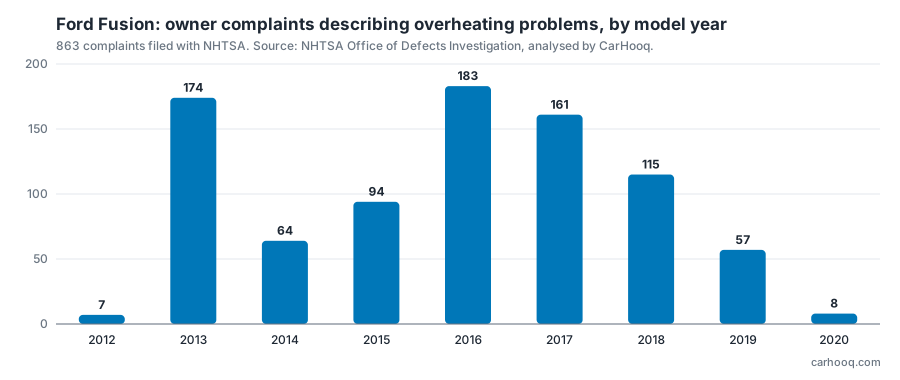
Which Ford Fusion years have the most overheating complaints?
| Model year | Reports | All complaints | Share |
|---|---|---|---|
| 2020 | 8 | 237 | 3.4% |
| 2019 | 57 | 473 | 12.1% |
| 2018 | 115 | 512 | 22.5% |
| 2017 | 161 | 1,204 | 13.4% |
| 2016 | 183 | 1,741 | 10.5% |
| 2015 | 94 | 1,066 | 8.8% |
| 2014 | 64 | 1,435 | 4.5% |
| 2013 | 174 | 1,958 | 8.9% |
| 2012 | 7 | 2,619 | 0.3% |
The reports cluster in 2013 and in 2015 to 2018. The 2012 car has only 7 overheating reports among 2,619 complaints, so this is not a problem that shows up evenly across the model. In 2018, more than one complaint in five is about overheating or coolant loss, the highest share in the table. The 2019 and 2020 cars have fewer reports, but they have also had less time on the road.
What do Fusion owners describe?
Several of the quotes below name the 1.5L or 2.0L EcoBoost engine. The complaints describe what owners were told or found, and I have not checked any of it myself.
Coolant going missing with no visible leak. One 2015 owner wrote that the car "routinely runs hot, losing coolant rapidly with no external signs of a visible hose or radiator leak" (complaint 11762932). A 2014 owner wrote: "Ford dealership diagnosed coolant intrusion requiring full engine replacement costing approximately $14,000" (11737935).
Coolant found inside the cylinders. A 2018 owner wrote that a dealer pressure test "showed an immediate 5 PSI drop within 10 minutes" and that a borescope "confirmed that engine coolant is actively leaking across the block interface and pooling directly inside the engine cylinders (cylinders 2 and 3)" (11766837). A 2016 owner said the car threw a code about a cylinder 4 misfire and the dealer "confirmed that there is coolant leaking into cylinder 4" (11765098).
Misfires and limp mode. A 2015 owner described a car that "started misfiring upon cold start for about 5-10 seconds" and later while driving (11742479). A 2016 owner wrote about the 2.0L engine "overheating and going into limp mode" (11769988).
Cooling fan failure. A 2020 owner with the 1.5L engine wrote that the cooling fan "became inoperable and blew three fuses", that the A/C blew warm air about 2 days earlier, and that the engine temperature lamp came on once, at which point they stopped driving and had the car towed (11757150).
Hoses and head gaskets. A 2013 owner wrote: "Vehicle blew upper radiator hose due to blown head gasket" (11758036). A 2012 complaint relays that the car "overheated while driven at various speeds" and that the owner's husband, a certified mechanic, replaced one water hose (11376281).
Fire. One 2013 owner described a fire on the interstate: "we noticed smoke in the rearview mirror. We pulled over right away, and within seconds of getting out, the car was engulfed in flames." They wrote that neither person was physically injured and that the car was equipped with the 1.6L GTDI EcoBoost engine and falls within the population of Safety Recall 17S09 / NHTSA 17V-209 (11766038). In all, 29 reports mention a fire.
Several owners say their VIN was outside a recall. The 2016 owner above was told "my VIN did not qualify for the recall that is only for the ecoboost 2.0 liter engines even though they have the same defect." That is the owner's account of the dealer's answer, not a statement from Ford. Reports also name Ford service documents, such as TSB 22-2322 in a 2017 complaint, but I have not read them, so I will not describe what they say.
By NHTSA component, the reports name Engine (663), Engine And Engine Cooling (182), Power Train (74), Fuel/Propulsion System (40), Electrical System (39) and Service Brakes (9). A report can name more than one.
Is there a recall for overheating on the Fusion?
NHTSA lists these campaigns that mention a Fusion and overheating or coolant:
| Campaign | Model years | What the recall says |
|---|---|---|
| 17V209000 (2017) | 2013 to 2014 Fusion, 1.6L GTDI | If the car is driven with insufficient coolant, the cylinder head may overheat, crack and leak oil, raising the risk of fire. Dealers install a coolant level sensor and supporting hardware and software, free of charge. Ford's number is 17S09. |
| 12V551000 (2012) | 2013 Fusion, 1.6L, built 3 February to 29 November 2012 | Coolant system leaks may cause the engine to overheat and leak flammable engine fluids, which could cause a fire on a hot exhaust. Dealers inspect for leaks and update the powertrain control module and instrument cluster software, free of charge. |
| 25V685000 (2025) | 2019 to 2020 Fusion | The engine block heater may crack and develop a coolant leak, causing a short circuit when plugged in, which can increase fire risk. Owners are advised not to plug in the block heater until it is remedied. Dealers replace it free of charge. |
None of the three covers a 1.5L or 2.0L EcoBoost overheating from coolant inside the cylinders, as far as these recall texts say. NHTSA also lists 18V592000, but that covers a 120V charge cord for plug-in models and is about the cord overheating, not the engine, so I have left it out of the table.
None of these recalls is marked "do not drive" in the data. Your own VIN decides whether you are covered, so look it up at the NHTSA recall checker.
What should you do if your Fusion overheats?
- Check your VIN for open recalls at nhtsa.gov/recalls. A recall can be open even if you have never had a warning light.
- If the temperature warning comes on, I would stop driving as soon as it is safe, as the 2020 owner above did. If the car loses power in traffic, get to a safe place and call for help.
- Write down dates, mileage, warning messages and the conditions: cold start, highway, stop and go, A/C on.
- Ask a dealer to check for open recalls and manufacturer service bulletins for your VIN, and ask for the findings in writing.
- Report the problem at nhtsa.gov/report-a-safety-problem. Complaints are how the numbers above get built.
- See the Ford Fusion problem report for the other complaint areas, and the year pages for 2016 and 2018.
How this guide was made
The numbers come from NHTSA owner complaints and recall records for the Ford Fusion, as of 9 November 2026. A complaint counts as an overheating report when the owner's text matches this symptom: overheating, coolant loss or a coolant leak. Quotes are copied from the complaints, with capital letters normalised. NHTSA does not check the accounts. See the methodology for how reports are matched.