Ford Fusion power steering problems: what 1,023 owners reported
Owners filed 1,023 complaints with NHTSA describing the power steering on the Ford Fusion failing, locking up or turning heavy. That is 9.1% of the 11,219 complaints on file for the model. The reports cover model years 2012 to 2018, and the 2012 model year alone accounts for 625 of them.
NHTSA lists five steering recalls that touch the Fusion, including two for corroding steering gear motor bolts and one for electric power assist shutting down. Whether one applies depends on your model year, build date and VIN, so check it first. 29 of the 1,023 reports mention a crash, none mention a fire, and the reports list 7 injuries in total. If this is not your case, read the full Ford Fusion problem report.
TL;DR
- 1,023 Fusion complaints (9.1% of 11,219) describe power steering failing, locking up or turning heavy.
- The worst model year is 2012 (625 reports, 23.9% of that year's complaints), then 2013 (161) and 2014 (113).
- 29 reports mention a crash, 0 mention a fire, and the reports list 7 injuries in total.
- The most named components are Steering (983), Electrical System (80) and Electronic Stability Control (43).
- Five steering recalls are on file: 19V632000, 18V167000, 15V340000, 15V250000 and 13V232000.
- Several owners say their VIN was outside a recall that matches their symptoms. Always check your own VIN.
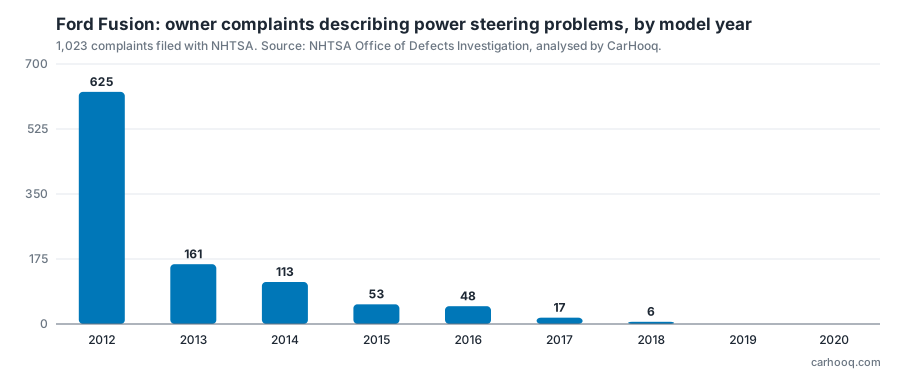
Which Ford Fusion years have the most power steering complaints?
| Model year | Reports | All complaints | Share |
|---|---|---|---|
| 2020 | 0 | 235 | 0% |
| 2019 | 0 | 472 | 0% |
| 2018 | 6 | 509 | 1.2% |
| 2017 | 17 | 1,203 | 1.4% |
| 2016 | 48 | 1,728 | 2.8% |
| 2015 | 53 | 1,066 | 5.0% |
| 2014 | 113 | 1,432 | 7.9% |
| 2013 | 161 | 1,957 | 8.2% |
| 2012 | 625 | 2,617 | 23.9% |
The 2012 model year stands out: nearly one complaint in four for that year is about power steering. Reports fall steadily with each newer year, and none of the 2019 or 2020 complaints match this symptom. Newer cars have had less time on the road to collect complaints, so a low count for a recent year is not proof that it is trouble free.
What do Fusion owners describe?
The wording is consistent. Most owners describe a sudden loss of assist, a steering wheel that becomes very hard to turn, and dashboard warnings.
Sudden loss of assist while driving. A 2012 owner wrote: "Our 2012 Fusion suffered a sudden loss of power steering, was diagnosed with code U3000 at a Ford dealer" (NHTSA complaint 11766725). A 2015 owner described it coming and going: "The steering assist will suddenly disengage and re-engage without warning, making the vehicle extremely difficult to control" (11735316).
Heavy or locked steering with warning lights. A 2017 owner reported three lamps: "Steering Assist Fault Service Required Service AdvanceTrac Hill Start Assist Not Available" (11768560). A 2016 owner wrote that the "steering wheel locks up completely at slow speeds and it's difficult to turn the steering wheel when turning a corner or trying to back up" (11703736), and that the dashboard showed "Steering Assist Fault" first.
Wet roads and highway speeds. A 2013 hybrid owner reported that the steering "suddenly failed without warning during heavy rain" and "immediately became extremely stiff and difficult to turn" (11739868). A 2016 owner who read codes U0240 and C102D with a scanner wrote: "Speed limit is 70 m.p.h. I had to go 40 with my 4 ways on" (11710059).
Steering and stability systems failing together. A 2014 owner reported "a loss of communication with the Power Steering Control Module (PSCM), accompanied by faults affecting the ABS and traction/stability control systems" (11772002). That fits the data: Electrical System (80) and Electronic Stability Control (43) are the next most named components after Steering (983). Power Train (23), Engine (15) and Service Brakes (15) appear far less often.
Corroded bolts and recall disputes. A 2015 owner wrote that the "steering gear motor attachment bolts have fractured due to severe corrosion" and that "Ford is denying the recall repair because this specific VIN was not included on the original mailing list" (11731165). A 2014 owner received a dash message, "Power Steering Failed. Service Now", and had the car towed to a dealer (11771177). These are owner accounts and have not been verified by NHTSA.
Repeat failures. A 2017 owner wrote: "The rack and pinion has failed twice within 2 and a half years" (11760256).
One 2018 report is a different case: the engine shut off and the owner lost power steering because of the lack of engine power (11728930). That is a stalling event, not a steering fault.
Is there a recall for power steering on the Ford Fusion?
Yes, several. NHTSA's recall data as of the brief date lists these steering recalls that cover the Fusion:
| Campaign | Model years | Defect | Fix |
|---|---|---|---|
| 19V632000 (August 2019) | 2013 to 2016 | Road salt or contaminants may corrode the steering gear motor bolts; the motor may detach, causing loss of assist. Applies to vehicles originally sold or registered in certain states. | Dealers replace the bolts and apply a wax sealer; a new steering gear if bolts are broken or missing. Free of charge. |
| 18V167000 (March 2018) | 2014 to 2018 | The steering wheel retaining bolt may loosen, allowing the wheel to detach while driving. | Dealers replace the bolt with a longer bolt, free of charge. |
| 15V340000 (June 2015) | 2012 | Electric power steering assist may shut down; more steering effort at lower speeds. | Dealers check the Power Steering Control Module for diagnostic trouble codes; the steering gear is replaced if loss-of-assist codes are found, otherwise the module software is updated. Free of charge. |
| 15V250000 (April 2015) | 2013 to 2015 | Corroding steering gear motor bolts, in certain states. | Dealers apply sealer and replace the bolts as required; a new steering gear if bolts are broken or missing. Free of charge. |
| 13V232000 (May 2013) | 2013 | Fusions built April 19 to 23, 2013 may have steering gears missing an internal retaining clip. | Dealers replace the steering gear, free of charge. |
None of these recalls is marked "do not drive" in NHTSA's data. Ford's customer service number in the recall text is 1-866-436-7332. The two bolt recalls are limited to vehicles sold or registered in listed states, and the 2013 recall to a short build window, so a Fusion can match the symptom without being in a recall. Several owners above say exactly that. A repair for one recall also may not be the whole story: one 2012 owner said the electrical part of their recall was done but the steering shaft was not (11758395). I cannot say from this data whether any of these cases were handled correctly, only that owners reported them.
What does the UK MOT data show?
The MOT tests steering, so it is worth a look, with a caveat. For UK-registered Fusions tested in 2023, the failure rates by first registration year were 20.4% (2015, 17,831 tests), 17.6% (2016, 16,492 tests), 16.4% (2017, 11,111 tests), 15.0% (2018, 7,264 tests), 17.1% (2019, 4,582 tests) and 15.7% (2020, 2,308 tests). The top three failure categories were tyres, lights and electrics, and brakes or visibility. Steering did not appear among the top three reasons for any of these years, so the MOT data does not point to a steering problem on the UK Fusion. The US complaints concern electric power assist faults that may not show up as a test failure.
What should you do if your Fusion power steering fails or turns heavy?
- Check open recalls by VIN at NHTSA's recall lookup. I would do this before anything else, because the recalls above are free repairs.
- If you see "Steering Assist Fault" or a similar message, treat it as a safety issue. Owners describe the wheel becoming very hard to turn, especially at low speed.
- Write down the date, mileage, warning messages, weather and speed when it happens, and any codes a dealer reads.
- Ask a dealer to check for open recalls and manufacturer service bulletins for your VIN and to tell you in writing what they found.
- If your car shows the symptoms but your VIN is not covered, report it at NHTSA's safety problem page. Owner reports are what this guide is built from.
- If the steering becomes heavy while driving, slow down gradually, use your hazard lights and stop somewhere safe. If the car is not safe to drive, call for help rather than continuing.
How this guide was made
The counts come from owner complaints filed with NHTSA, matched to power steering by the text of each complaint, as of 27 October 2026. Recall details come from NHTSA's recall records. Owner quotes are shortened but not reworded; the personal details are redacted in the original. Method and limits are on the methodology page. Complaints are unverified owner statements, not confirmed defects.