Tesla Model 3 phantom braking problems: what 603 owners reported
Owners who filed complaints with NHTSA describe the Tesla Model 3 braking suddenly and hard with nothing ahead of it, usually on a highway with cruise control or driver assistance switched on. NHTSA holds 603 such reports, which is 13.7% of the 4,407 complaints filed for the Model 3. The 2021 and 2022 model years account for 370 of them.
NHTSA's recall data includes one campaign, 21V846000, for unexpected activation of the automatic emergency brake on 2017-2021 Model 3 cars running one specific software version. It does not cover every report here. If this is not your case, read the full Tesla Model 3 problem report.
TL;DR
- 603 complaints describe sudden, unexpected braking, 13.7% of 4,407 Model 3 complaints.
- Worst model years by count: 2022 (223 reports), 2021 (147), 2020 (63) and 2018 (56).
- Worst by share of that year's complaints: 2022 (28.8%) and 2021 (21.7%).
- 566 reports name Forward Collision Avoidance, 161 Service Brakes and 156 Vehicle Speed Control.
- 10 reports mention a crash, none mention a fire, and the reports list 4 injuries in total.
- Recall 21V846000 (2017-2021 Model 3) covers unexpected automatic emergency braking, fixed by a free over-the-air update.
- Check your VIN at https://www.nhtsa.gov/recalls and report problems at https://www.nhtsa.gov/report-a-safety-problem.
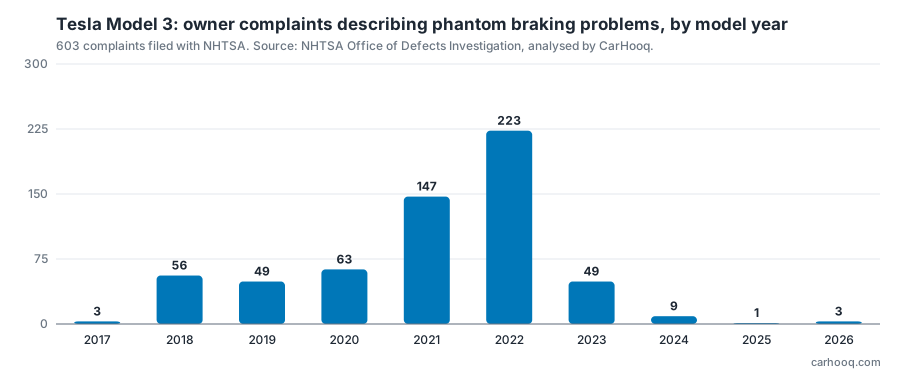
Which Tesla Model 3 years have the most phantom braking complaints?
| Model year | Reports | All complaints | Share |
|---|---|---|---|
| 2026 | 3 | 31 | 9.7% |
| 2025 | 1 | 127 | 0.8% |
| 2024 | 9 | 224 | 4.0% |
| 2023 | 49 | 431 | 11.4% |
| 2022 | 223 | 775 | 28.8% |
| 2021 | 147 | 677 | 21.7% |
| 2020 | 63 | 455 | 13.8% |
| 2019 | 49 | 623 | 7.9% |
| 2018 | 56 | 1,037 | 5.4% |
| 2017 | 3 | 27 | 11.1% |
The complaints cluster in 2021 and 2022, where more than one in five complaints is about unexpected braking. The 2018 model year has the most complaints overall (1,037), but braking is a smaller part of that mix at 5.4%. The 2024 to 2026 cars have few reports, which fits with them having had less time on the road, so a low count there is not proof that they are unaffected.
What do Model 3 owners describe?
Highway driving with cruise control. Most quotes describe a sudden slowdown at speed. A 2019 owner wrote: "I was on cruise control going 60 mph when suddenly my car braked suddenly and inappropriately, losing at least 20 mph in a split second" (NHTSA 11658874). A 2021 owner reported four events at the posted 70 mph limit, where "the car suddenly slammed on the brakes and decelerated to less than 30 mph" (NHTSA 11737015). A 2018 owner described cruise control, not FSD, braking "sometimes aggressively" and said the car "swerved slightly" on one occasion (NHTSA 11695523).
With nothing visible ahead. Owners say the braking came without an obstacle. A 2022 owner wrote that the car "abruptly decelerated without any visible vehicle, pedestrian, debris, or other obstacle requiring braking" with Full Self-Driving (Supervised) engaged (NHTSA 11751194). A 2025 owner reported "Phantom braking from freeway speed to almost a stop, with no other vehicles presenting issues nearby. Three occurrences so far" (NHTSA 11664926).
At night or near parked vehicles. A 2020 owner wrote that the braking "only happens at night" and that "It slams on the brakes as if it is about to crash when nothing is ahead" (NHTSA 11581449). A 2023 owner with adaptive cruise control set at 75 mph said the car "suddenly slammed on the brakes automatically" about 30 yards from a car parked on the shoulder (NHTSA 11759922).
Without driver assistance. One 2021 owner reported strong braking for about 1 to 2 seconds at roughly 45 mph while driving manually, and said "Neither Autopilot, FSD, nor Traffic-Aware Cruise Control was engaged" (NHTSA 11768851).
What the car does around it. In the 603 reports, the components named most often are Forward Collision Avoidance (566), Service Brakes (161), Vehicle Speed Control (156), Electrical System (17), Lane Departure (13) and Power Train (3). Ten reports mention a crash. One 2026 owner described a low-speed rear-end collision with FSD engaged, with "a sudden accleration right before the hit along with a sudden braking" (NHTSA 11766182). Some owners also describe a worry about following traffic: "If anyone was behind me, they would have crashed into me" (NHTSA 11581449).
These are owner descriptions filed with NHTSA. They have not all been verified, and they do not establish a cause.
Is there a recall for phantom braking on the Model 3?
Three Tesla campaigns in NHTSA's data touch the forward collision avoidance system on these model years. Only the first is about unexpected braking.
| Campaign | Model years | What the recall says | Fix |
|---|---|---|---|
| 21V846000 (29 Oct 2021) | 2017-2021 (Model 3 included) | A communication error in cars running software 2021.36.5.2 may cause false forward-collision warning or unexpected activation of the automatic emergency brake. Risk: the car may stop suddenly, increasing the risk of a crash. | Free over-the-air software update, recall began 25 October 2021. Tesla number SB-21-00-004. |
| 22V317000 (9 May 2022) | 2020-2021 Model 3 | Fisheye and narrow camera cable terminals were installed incorrectly, swapping camera views. Risk: impaired Autosteer and AEB performance. | Tesla Service corrects the terminals and recalibrates the cameras, free of charge. Tesla number SB-22-17-007. |
| 24V153000 (27 Feb 2024) | 2018-2022 Model 3 | A factory reset muted Pedestrian Warning System sounds. This is a sound requirement issue, not a braking issue. | Free over-the-air update, release 2023.44.30.14. Tesla number SB-24-00-006. |
Recall 21V846000 is the one that matches the symptom, and it names a specific software version. The 22V317000 and 24V153000 recalls are listed because they concern the same safety system, not because the recall text says they cause sudden braking. Owners may contact Tesla customer service at 1-877-798-3752. No recall text in this data says that every reported event is covered.
What should you do if your Model 3 brakes for no reason?
- Check your VIN for open recalls at https://www.nhtsa.gov/recalls. I would do this first, because 21V846000 and 22V317000 are free fixes.
- Write down the date, speed, road, weather, time of day, whether cruise control, Autopilot or FSD was on, and any message on the screen. One owner in the reports noted that the screen showed an outline of a person that was not there.
- Report it to NHTSA at https://www.nhtsa.gov/report-a-safety-problem. Reports are how the numbers in this guide exist.
- Ask Tesla service to check for open recalls and service bulletins, and keep the written answer.
- If the car brakes hard in traffic, take manual control, and if it keeps happening, I would stop using the feature involved until it has been checked.
- If the car loses power or stops in a live lane, put the hazard lights on, move to a safe place if you can and call for help.
How this guide was made
The data comes from NHTSA owner complaints and recall records for the Tesla Model 3, as of 16 November 2026. Reports were selected where the owner's own description matches sudden, unexpected automatic braking. Counts are of complaints, not of cars, and a complaint is not a confirmed defect. The method is explained in the methodology.