Tesla Model Y phantom braking problems: what 623 owners reported
Owners have sent NHTSA 623 complaints about Tesla Model Y cars braking suddenly with nothing in the way. That is 15.9% of the 3,927 Model Y complaints on file, and the reports are concentrated in model years 2021, 2022 and 2023. Most of them describe the braking happening while adaptive cruise control, Autopilot or Full Self-Driving (Supervised) was in use.
A recall exists for a related fault: campaign 21V846000 (October 2021) says a communication error may cause a false forward-collision warning or unexpected activation of the automatic emergency brake on certain 2020-2021 Model Y cars running one specific software version. If this is not your case, read the full Tesla Model Y problem report.
TL;DR
- 623 Model Y complaints describe sudden, unexpected automatic braking ("phantom braking"), 15.9% of all 3,927 Model Y complaints.
- Model year 2021 has the most reports (246), then 2022 (182) and 2023 (149).
- 19 reports mention a crash and 1 mentions a fire; the reports list 10 injuries in total.
- The component named most often is Forward Collision Avoidance (587 reports), then Service Brakes (171) and Vehicle Speed Control (131).
- Recall 21V846000 (2020-2021 Model Y, software version 2021.36.5.2) covers false forward-collision warnings and unexpected automatic emergency braking, fixed by an over-the-air update.
- Recall 24V153000 is about muted pedestrian warning sounds, not braking.
- Check your own VIN at nhtsa.gov/recalls rather than relying on a model year.
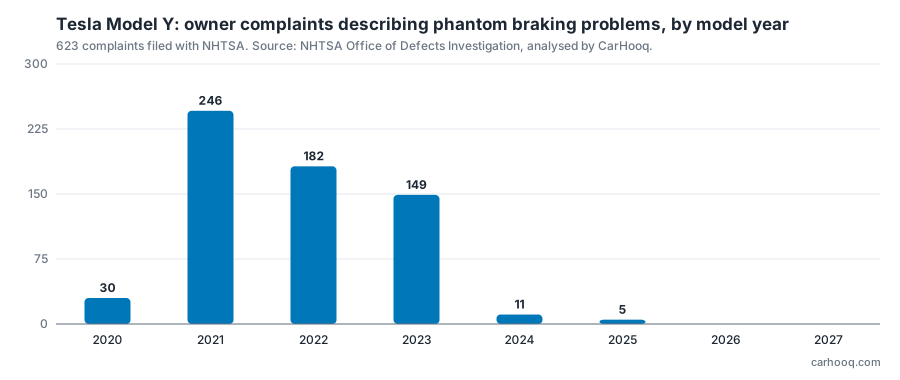
Which Tesla Model Y years have the most phantom braking complaints?
| Model year | Reports | All complaints | Share |
|---|---|---|---|
| 2025 | 5 | 116 | 4.3% |
| 2024 | 11 | 340 | 3.2% |
| 2023 | 149 | 1,198 | 12.4% |
| 2022 | 182 | 882 | 20.6% |
| 2021 | 246 | 1,101 | 22.3% |
| 2020 | 30 | 285 | 10.5% |
The cluster is 2021 and 2022: more than one in five complaints for those years is about sudden braking. 2021 also has the highest raw count, with 246 reports. The 2020 model year has far fewer complaints overall (285). The 2024 and 2025 years show very few reports (11 and 5), but those cars have had less time on the road, so I would not read that as proof the problem is gone. The 2026 and 2027 model years have no reports in this data.
What do Model Y owners describe?
It happens with cruise control or driver assistance on. One 2022 owner (complaint 11762300) wrote: "almost everytime im in adaptive cruise control it randomly brakes. Today with nothing in front of my on 3 separate occasions it applies the brakes and forces me to accelerate to maintain speed." A 2020 owner (complaint 11548079) wrote: "I was driving with cruise control on and the car violently hit the brakes when there was no one in front of us. We have noticed this is more common when cresting a hill."
It can happen at freeway speed. A report on a 2023 car with 40,531 miles (complaint 11720823) says: "the vehicle unexpectedly performed a sudden full stop at freeway speed. There was no visible obstruction in front of the vehicle." The same owner adds: "Multiple vehicles behind me had to brake abruptly to avoid a rear-end collision." Another owner (complaint 11764224) lists "Phantom braking on busy freeways" among several issues over five years of ownership.
It is not always a single event. A 2020 owner using FSD (Supervised) (complaint 11757733) wrote that the vehicle "has repeatedly performed sudden braking in active traffic without any obstacles present, causing physical jolting and creating a risk of collision." A 2023 owner (complaint 11762976) described a car that, while using Autopilot or FSD, "repeatedly exhibited phantom braking, including sometimes coming to a complete stop for no reason."
Warning messages are rarely mentioned. In complaint 11720823 the owner says "The system did not provide any audible or visual warning before the sudden braking." One owner (complaint 11757562) reported three alert codes on the same drive as phantom braking and speed changes: UI_a111, APP_w207 and DI_a175. That is one owner's list, and the complaint does not say what those codes mean.
A few reports describe the opposite problem. Some owners say the automatic braking did not act when they expected it to. In complaint 11770678 the owner wrote: "I did not receive any audible or visual Forward Collision Warning (FCW). I also did not observe the Automatic Emergency Braking (AEB) system activating or attempting to slow the vehicle before impact." These sit in the same component category, Forward Collision Avoidance, as the phantom braking reports.
Crashes and the most serious reports. 19 reports mention a crash and 1 mentions a fire, and the reports list 10 injuries in total. One report on a 2023 car (complaint 11765505) describes "an uncommanded, severe "phantom braking" event and simultaneous steering lock." These are owner descriptions filed with NHTSA, not findings by NHTSA or Tesla about the cause.
Besides Forward Collision Avoidance (587), Service Brakes (171) and Vehicle Speed Control (131), owners also tagged Electrical System (29), Lane Departure (27) and Steering (7). One report (complaint 11762976) says Tesla Service was told about the problem repeatedly; another (complaint 11757733) says "Tesla service has stated that no error codes…" and the text is cut off there in the source.
Is there a recall for phantom braking on the Model Y?
There is one recall that matches the symptom for some cars:
- Campaign 21V846000 (29 October 2021; the recall began 25 October 2021). Tesla recalled certain 2017-2021 Model S, Model 3 and Model X and 2020-2021 Model Y vehicles operating software version 2021.36.5.2. The defect: "A communication error may cause false forward-collision warning (FCW) or unexpected activation of the automatic emergency brake (AEB) system." The stated risk: unexpected activation of the AEB system may cause the car to stop suddenly, increasing the risk of a crash. The fix is a free over-the-air software update, and Tesla's number for this recall is SB-21-00-004. Owners may contact Tesla customer service on 1-877-798-3752. The recall does not say to park the car.
The recall names one software version, so it cannot explain complaints from later model years or cars on other software. Nothing in the recall text says it covers every phantom braking report.
A second recall in the data, campaign 24V153000 (February 2024), covers certain 2020-2022 Model Y cars among others. It concerns a factory reset that muted the Pedestrian Warning System sounds, so it is not a braking recall. Its fix is software release 2023.44.30.14, sent over the air.
For recalls on other parts, see the Model Y problem report.
What should you do if your Model Y brakes for no reason?
I am not a mechanic, and I would not try to diagnose this myself. These are the steps I would take, all from official sources or plain common sense:
- Check your VIN for open recalls at nhtsa.gov/recalls. Recall 21V846000 applies to certain cars on one software version, so the VIN check is the reliable answer.
- Report the problem at NHTSA's safety problem page. The complaints above are the data that regulators and other owners can see.
- Write down the date, time, road, speed, mileage, whether cruise control, Autopilot or FSD was on, the software version, and any message or alert code on screen. The reports quoted above are most useful when they include these details.
- Contact Tesla service and ask whether any open recall or manufacturer service bulletin applies to your car. Keep a written record of what they say.
- If the car stops or loses power in traffic, stop driving it and call for help once you are safe.
If you are buying a used Model Y, I would ask the seller for the software history and service records, and check the VIN for open recalls before viewing.
How this guide was made
The data comes from the NHTSA complaints database, where owners describe problems in their own words. Complaints were matched to this symptom from the owner text and component fields, and counted by model year; the data brief is dated 16 November 2026. Owner quotes are copied from the complaint text, with capital letters converted to normal sentence case. See how the carhooq data is built for the full method.