How to use Mercedes MBUX? A complete guide for MBUX
You use Mercedes MBUX in four ways: the black touchpad on the right of the steering wheel controls the central screen, the one on the left controls the instrument display, there is a touchpad on the centre console, and the central display is also a touchscreen. On top of that you can talk to it with "Hey Mercedes". Everything sits in six menus: Phone, Navigation, Radio and Media, Comfort, Info and Settings. This guide walks through each menu and the settings I recommend.
The car in this walkthrough has pretty much every option ticked, so some things here won't be on your car. If you're not sure what your car has, ask your local Mercedes-Benz dealer for the factory spec sheet.
TL;DR
- Controls: steering wheel touchpads (right = central screen, left = instrument display), centre touchpad, touchscreen and "Hey Mercedes" voice.
- Phones: two phones for calls at the same time plus a third for music; the car stores up to 20 devices.
- Navigation: augmented reality draws a blue arrow over the camera picture; traffic light view is off by default.
- Ambient light: multi-colour mode cycles between two colours every 40 seconds to a minute.
- Exterior light delay: 15 to 60 seconds on most Mercedes.
- Selling the car: use Factory settings to wipe the sat nav and all phones.
- If you only want the basics, read 15 Mercedes-Benz MBUX tips and tricks.
What is in each MBUX menu?
| Menu | What you find there |
|---|---|
| Phone | Two phones for calls, contacts, favourites, text messages, connected devices |
| Navigation | Fuel, car parks, destination entry, augmented reality, route settings, traffic |
| Radio and Media | Stations, favourites, traffic announcements, equalizer, Bluetooth and USB media |
| Comfort | Seat kinetics, seat heating balance, ambient lighting, energizing comfort |
| Info | Vehicle data, engine data (AMG), consumption, owner's manual, apps, browser |
| Settings | Quick access, assistance, vehicle, lights, system, voice, Wi-Fi, factory reset |
There's a touchpad down on the centre console, and you can also use the central display as a touchscreen. These are the sections covered in this post:
1. How do you connect a phone to MBUX?
MBUX can connect a phone, but did you know it can also accept two phones? You can connect your phone via Bluetooth and also a friend's or partner's phone, or a personal phone and a work phone.
Both phones are connected at the same time. If either phone receives an incoming call, you simply swipe up or down on the steering wheel touchpad to answer, hang up or send it to voicemail.

1.1 How to Connect your Phone with Mercedes MBUX
To connect a phone:
- On your phone, go to Settings, then Bluetooth.
- On the car's screen, go to Connect device. The car will find your phone; select it and follow the prompts that come up.
It'll ask if you are happy to connect.
Tap pair, then tap allow, and within seconds it's done. You'll see Phone 1 and Phone 2 at the top of the screen; a second phone shows up there the same way.
Tap List to see all the calls you've made, received or missed. The arrow next to an entry opens that contact so you can see all their information, such as the address.
1.2 Mobile contacts
Next up is Contacts. This loads your entire phone book, as a mirror of the one on your phone.
If you add someone to your phone book it will appear here, and if you delete someone it will be deleted here too. It synchronizes the next time you get out of the car and back in again.
The Favorites button lets you add people you call daily. Scroll down the list to add a favorite and it appears on the screen.
To delete a favorite, hold your finger on the touchscreen or the touchpad and you can delete it. It's a bit like your phone, where you hold an icon and they all start wiggling and you can move them around.
At the very bottom, the first button brings up your phone book again (just another way of searching), the next is a traditional keypad to dial a number, and the next shows you text messages.
If you want text messages to come through to the screen on an iPhone, go to the Bluetooth menu, tap the i next to your car and turn on Show Notifications.
For Android users, the phone will prompt you when you first connect it. It will only show you unread messages.
1.3 Connected Devices
The next button shows the devices your car has connected to. You can have three connected at the same time, and the car can store up to 20 devices.
Finally, the phone settings, which you won't often need, have these options:
- Contacts synchronizing
- Phone call volume (you can also change it on the steering wheel during a call)
- Ringtone in the car
- Message display: you can stop messages from coming in completely
At the very top there's a General button. It's another way of viewing the device manager. Name format is quite useful: it changes whether your phone book is displayed and sorted by first name or surname. Me personally, I prefer the first name because that's how I address everyone, but I know some people prefer the surname, and I think most cars arrive with the surname first.
Finally there are Import contacts and Delete contacts. The only reason to go in there is if you have an older phone that doesn't synchronize the phone book automatically. Most of the time your phone book syncs on its own.
2. How do you use MBUX navigation?
Now let's head over to navigation, also known as the sat nav.
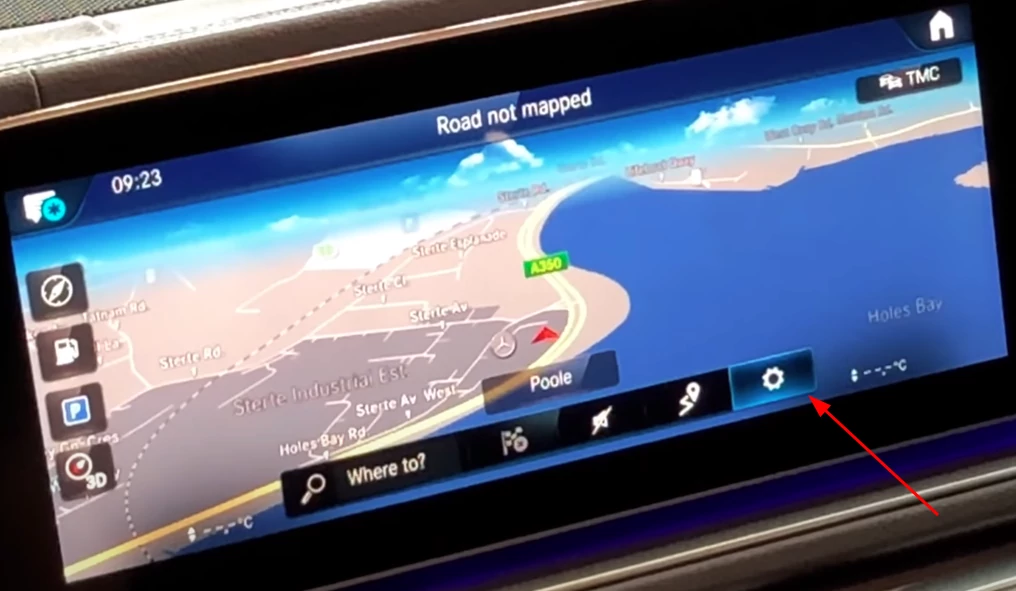
On the far left there's the fuel button. Depending on the time of day you may also see a knife and fork: MBUX shows the knife and fork at lunch time or dinner time.
The fuel button lists all the fuel stations nearby. Scroll down the list and the arrow on the left shows the direction of each one based on the way the car is facing, and it re-orientates as you drive. Select the one you want and press the big arrow to go.
Below that are the car parks: all the car parks nearby, shown on the map.
Underneath that there is a compass, which controls the orientation of the map. Most cars arrive set to north up.
Underneath that is the button to start the sat nav. It asks where you want to go: you can type in a postcode, for example (you don't need to put the space in), and it searches and brings up suggestions as you type.
2.1 Starting the sat nav and augmented reality
Start the sat nav with the big blue arrow. By default the voice guidance will start talking; you can mute it if you prefer.
This car has augmented reality: a camera at the top of the windscreen looks ahead all the time, and the system digitally draws a blue arrow over the camera picture on the screen to show you exactly which way to go while you drive.
If you don't like it, there is a button on the left-hand side to turn it on or off. If you do have it, it's a neat thing to have, and if I'm not mistaken it was the only system in the world with it at the time.
Swipe anywhere on the touchpad to bring up the menu. With the sat nav running, the menu disappears to give you maximum viewing space. This is also where you add another destination.
Now the advanced menus. Route settings gives you a route overview and shows your waypoints. You can move them up and down the list, so if you had point A, point B and point C, you could swap point C with point B.
2.2 Car-to-X communication
Report traffic incident is another neat feature. It lets you report an incident on the road, say someone has pulled over on the motorway and is causing an obstruction.
The report goes to all other cars with the same technology. This is what's called Car-to-X communication. It reports incidents on the road a lot quicker than traditional live traffic, but goes through the same channels.
The traffic option underneath turns on traffic announcements and area announcements.
2.3 Map settings
In the settings menu you'll find traffic, parking and motorway information. These are overlays on the sat nav map: live traffic shows as green, orange and red lines, and you can turn this on or off.
Car parks show as blue P symbols. Motorway information shows the services ahead on the screen in advance, for example 15, 20 or 30 miles away.
Under map orientation you can control the orientation of the map and the zoom level. You can zoom in and out on the touchpad or the screen anyway, but here you can turn on auto-zoom, which zooms in and out automatically depending on how fast you're going. I'd recommend leaving it on.
You can turn fuel stations on and off on the map. Range is a neat trick: it shows how far you can go with the fuel or electric charge left in your car. To see it, go to the map overview and zoom all the way out.
The traffic menu shows traffic incidents on the map.
Traffic light view is off by default. When you're first at a set of traffic lights you can usually see them fine, but sometimes they're hard to see from the driver's seat. With this enabled, the camera shows the traffic light on the screen, so you can just sit back and watch it there. I think that's quite a neat feature.
3. How do you set up the radio and media in MBUX?
Radio is one of the simpler menus. The stations you see are the ones available right now, and as you drive around the country the list changes.
To add a favourite, pick the station and add it at the bottom of the screen.
To change your favourites, hold your finger on one and you can move it up and down the list, delete it or replace it with another station. There are several pages of favourites.
After that there's mute and unmute, and TA for traffic announcements.
The settings let you change the equalizer, so if you're a true audio enthusiast you can adjust the bass, mid and treble, and the balance and fader to choose where the sound focuses. This car has the Burmester sound system.
For me, I don't listen to the radio that much; I listen to music off my phone, which brings us to Media.
Media includes Bluetooth for connecting your phone wirelessly. Don't forget you can have up to three phones connected: two for calls in and out, and the third as the DJ, the person who's playing the music.
This car has USB ports for plugging in phones; for certain phones you might need an adapter (dongle).
4. What is in the MBUX Comfort menu?
Not all Mercedes have the Comfort menu, and what's in it depends on the specification of your car.
This car has Seat Comfort, which includes seat kinetics. On a long journey you'll probably shift around in your seat a few times. Seat kinetics makes small movements in parts of the seat to keep the muscles in your back moving without distracting you, to stop them aching after a long drive.
You can have it on for the driver or passenger. In settings you can have the backrest and seat surface move independently or together, and choose how long the program runs.
4.1 Seat Heating
Next is the seat heating balance. You control the heated seats themselves on the door (max, medium, low and off). This setting controls where the heat comes from: just your back, or your legs as well. By default it heats the whole seat. Most of the time I would keep it in the middle.
A reset button sets all the seat settings back to zero.
4.2 Ambient Light
Next is ambient lighting, the colours you see around the inside of the car. They are stunning, and kids in the car will love them too. As you move the slider, the colour changes; my favourite is the blue, which is the brightest.
You can also choose multi-colour, such as red and blue, red and yellow, or blue and yellow. A multi-colour animation cycles between the two colours roughly every 40 seconds to a minute; you can switch that off if you don't like it.
Welcome and climate are effects that show off the ambient lighting. For example, if you turn the climate control warmer the lights go red, and colder they go blue.
On the previous screen you can also control the brightness if it's a bit too bright.
After this is energizing comfort. These programs combine the things you feel and touch in the car: seat kinetics, lighting, air conditioning and fragrance.
In cars with the built-in air freshener (air balance package), a program such as the seaside one changes the lights to green and blue, changes the air conditioning and turns on the fragrance, to help change your mood after a stressful day. Training is another program that helps relax muscles.
Some might call it gimmicky, but the system talks you through exercises you can do safely behind the wheel, such as rolling your shoulders forwards and backwards, to keep your muscles as mobile as possible. Always keep your eyes on the road.
I think it's mostly for people who do a lot of motorway miles each year. Tips are similar to training, but as individual items you can listen to, while training is a full audio program. Energizing coach extends the energizing comfort program with extra data from a Garmin smartwatch, if you have one.
5. What does the MBUX Info menu show?
The Info menu is aimed more at specialist cars, such as AMGs for track driving, or SUVs. For everyone else there's the owner's manual on here.
The vehicle data screen shows how hard you are pressing the accelerator and brake pedals, and on the left the suspension height adjustment (mainly for SUVs).
At the bottom is the pitch of the car when you're going up or down a hill.
Next is Engine, which is where AMGs come in. You can view the gearbox temperature and engine oil temperature, plus:
- Horsepower
- Torque in Newton meters
- Battery voltage
- Turbocharger air pressure
Consumption shows your average mpg. There's also an off-road score, which I haven't used yet because it had only just come to MBUX; I presume it's similar to the eco score that rates how economically you drive. Most people who buy SUVs don't take them off-road, but it's there if you need it.
The manual shows the owner's manual on the screen. There are a few ways to read the manual in a Mercedes-Benz: on the screen, in the printed book (usually in the glove box or the boot), in the Mercedes-Benz Guides app, which is the one I would use because it covers all years and models, or on the Mercedes-Benz USA owner's manuals page. On the screen you can even change the manual's language.
The Mercedes-Benz apps screen shows which account your car is linked to. If you have Apple CarPlay or Android Auto, you can launch them manually from here.
You'll need a cable plugged into the USB port marked with the white phone symbol.
There's also a browser in the car. It's greyed out while you're driving for safety, and you need a paid data package to use it. A modern smartphone will usually give you a quicker, more flexible experience.
If you have kids in the back with rear screens, for example in a GLS, they could browse the internet there. Then finally we get to Settings.
6. Which MBUX settings should you change?
These are all the settings you can change in the car, starting with the quick access menu.
Smaller cars, such as an A-Class, CLA, B-Class or GLA, might have about three or four quick access buttons.
M is for manual: changing gear yourself using the paddles behind the steering wheel. Tapping it puts the car into manual mode all the time.
The P with what looks like Wi-Fi symbols is your parking sensors. You can turn them off, although I can't think of a day-to-day reason to.
Next is active lane keeping assist. It monitors the road ahead and if it detects you crossing a white line, it can pull you back into the lane or just vibrate the steering wheel. Some cars also have the driving assistance package, the steering wheel symbol on the right, which helps you steer on motorways.
| Setting | Where | Recommendation in this guide |
|---|---|---|
| Auto-zoom | Navigation, map settings | On |
| Lane keeping assist | Assistance | Standard, or off if you don't like it |
| Maneuvering assistance | Assistance, camera and parking | On |
| Touchpad tap | System, controls | Off |
| Online voice recognition | System, voice | On |
| Factory settings | System | Use before you sell the car |
6.1 Head-up display (HUD)
HUD stands for head-up display. It shows the speed and other information on the windscreen, a bit like a fighter jet. You can turn it off here.
It works by projecting light from the dashboard up onto the windscreen.
6.2 Alarm, interior motion sensor and DSR
Next are tow-away protection and the interior motion sensor. You might turn off the exterior alarm or the interior sensor on a ferry, for example, or if you leave kids or pets in the car.
DSR, found on most SUVs, is the downhill speed regulator. Think of it as cruise control for going down a steep hill at walking speed, when you can't see over the crest. It holds the speed you select, from one to five miles an hour.
Some SUVs with air suspension also have a button that lowers the car to help you get in and out, which matters on tall cars like the GLS. The car goes back up when you start driving (see also how to lower the air suspension).
Many new cars now have car wash mode, which folds the mirrors in, sets the air to recirculation and makes sure the sunroof is closed, ready for a drive-through car wash.
6.3 Trailer assist
Next is the trailer coupling. On cars with a Mercedes-Benz fitted trailer coupling, one button swings the coupling out at the back. On MBUX cars it's on the screen, and there is usually a button in the boot as well.
Then the assistance menu, which needs the ignition on. The first section is camera and parking, where you can make the parking sensors louder.
You can change the pitch of the warning tones, and audio fade during warning tones turns down the radio or music from your phone when the sensors beep.
Maneuvering assistance is found on many new cars. If you reverse a bit too quickly towards a parked car, it can brake hard to stop the bump, like a slow-speed active brake assist. Don't test it on purpose, but I would keep it on.
Open camera cover opens the cover over the reversing camera. The cover opens and closes automatically when you reverse, drive or park, but this option is there in case there's residue or watermarks on the lens: open it, go round to the back and wipe it with a dry cloth. As soon as you turn the car off it closes again, so it's a manual way of opening the camera cover.
Traffic sign assist uses a camera at the top of the windscreen to read traffic signs and show the speed limit on the screen. You can set it to visual and audible, visual only or off, and set a threshold over the speed limit. Lane keeping assist has a few settings here too: I'd recommend leaving it on standard, or turn it off if you don't like it. Attention assist, which every Mercedes-Benz has, monitors how you drive and suggests a break if it detects you getting tired. You can switch it off or make it more sensitive.
Next is Vehicle. Here you can change Dynamic Select, how the car drives, which you can also do with the switch on the console. Winter tires: if you fit winter tires, there is a maximum speed you must not exceed, and you can set it here.
Automatic seat adjustment is on newer cars with memory seats: enter your height and the car moves the seat into what it thinks is the right driving position for you.
Belt adjustment: when you clip in, the belt pulls tight automatically every time. This only works in the front seats. If you don't like the tug, turn it off with the toggle.
Acoustic locking gives a short toot from the horn when you lock the car. It's personal preference, but useful for finding your car in a car park.
Automatic folding folds the mirrors in and out when you lock and open the car. There's also a button to do it manually.
Filling station search: when the car reaches the reserve fuel level, it recommends fuel stations on the left screen. Useful if you like to live life on the reserve.
Then Lights. There's another ambient lighting setting here, exactly the same as the one in Comfort. Dipped beams is for cars with Intelligent Light System or Multibeam LED: the headlights are set up for the side of the road you drive on so they don't dazzle others, and you can switch sides here without putting stickers on your lights.
Exterior light delayed switch-off is how long the lights stay on when you lock the car at night. On pretty much any Mercedes I've seen, you can choose 15 to 60 seconds.
Interior light delayed switch-off does the same for the interior lights.
Adaptive headlights move with your steering input to give you maximum visibility; the animation on screen shows how. Not all cars have them. Surround lighting switches on when you lock and open the car: lights behind the door handles or under the mirrors help you spot puddles at night.
Then System, which controls things like the themes on the screens.
Sport turns all the dials a yellowy gold colour, and Progressive gives a blue and orange look; it's your preference. You can change the display brightness here, although it adjusts automatically anyway. If the displays are too dim at night, there's a small toggle switch on the right that changes this.
Display off switches the central screen off so you can focus on the instrument display with your speed and revs; any button brings it back. By default the car switches automatically between day and night design: bright colours on the sat nav during the day and very dark at night.
Next is Controls. I wouldn't change much here unless you want to change the sensitivity of the touchpads. You can enable touchpad tap: by default you press the touchpad down firmly to select something, while touchpad tap selects with a light tap, like a laptop. I'd rather leave it off, because you can accidentally open a menu you didn't mean to.
LINGUATRONIC is the Mercedes name for voice control, including the "Hey Mercedes" feature in MBUX. I've switched it off at the moment, which is why it hasn't gone off every time I say Mercedes. Switch it on, say "Hey Mercedes" and the voice assistant asks how it can help, and you can give it commands.
Online voice recognition lets it connect to the internet through your Mercedes me account (now the Mercedes-Benz app in the US), so you can ask about the weather and more. I'd always leave this on because it makes the assistant even better. Below this are the audio settings we've already covered.
Next is Wi-Fi and Bluetooth. You can turn Bluetooth off, but it's better to leave it on. NFC lets some Android phones, such as Samsung, connect by holding the phone in the marked area; it does nothing for iPhones, so you can leave it on or off. You can also turn off the car's Wi-Fi. Bear in mind the hotspot needs a paid monthly plan.
Transmit vehicle position is part of the Mercedes me services and switches on automatically when you turn those services on, so you can locate the car on a map. It's usually chargeable, although some cars get it free for three years.
Language changes the language of the whole system, including the voice assistant. There are a lot of languages. Units changes the speed readings from miles an hour to kilometres an hour, for example if you drive in Europe.
License activation shows the licenses active in the car, such as wired Android Auto and Apple CarPlay, which you can buy if your car doesn't have them.
Factory settings resets everything, which you should do when you sell the car: it wipes the sat nav, deletes all the phones and puts the system back to factory settings.
Read more about: Mercedes MBUX tips and tricks